What Is a Parallel Run? The Safest Way to Go Live on a New Insurance Platform
Every core system replacement has one moment nobody wants to own: the day the old system goes off and the new one goes on. A parallel run removes that moment. The new platform processes the same real work as your legacy system, side by side, and you compare the results before anything is switched.
Nothing goes live until you have the evidence and you sign off. Here's how it works, what you check, and what happens after.
What is a parallel run, and why is it the safest way to go live?
A parallel run is a validation period where the new platform and the legacy system both process the same live work at the same time. Policies, endorsements, claims, and billing events flow through both. The outputs are compared, and every discrepancy is investigated and resolved before the carrier decides to switch.
The point is to replace assumption with evidence. You don't have to trust that the new system will behave on go-live day.
You've already watched it behave on your real book, for weeks. The old system kept running the whole time.
Three things make it work:
- The legacy system never stops. Business operations continue through the whole validation period.
- The comparison is on real work, not test cases. Same policies, same claims, same rules.
- The exit is defined in advance. Formal acceptance criteria are agreed before the parallel run begins, so "ready" isn't negotiated under pressure.
At Force, the parallel run is Phase 03 of every implementation, and it continues until both sides confirm the system is ready.
Why is go-live the riskiest moment in a core system replacement?
Because in the traditional model it's an all-or-nothing event. The legacy system is switched off, the new one is switched on, and the business finds out in production whether two years of configuration were right.
That's the shape of the project behind the failure rate. BCG's research puts the share of corporate transformations that fail to create value at 74%, and its insurance practice applies the same figure to carriers. In the 2025 West Monroe survey of insurance executives, 52% said they had delayed or canceled two to three major technology projects in the past year for budget reasons.
The common thread is that a single cutover concentrates all the risk into one day. If the rating comes out wrong, every quote that day is wrong.
If a document template breaks, every policy issued that day is wrong. A parallel run spreads that risk across weeks, on a system that isn't yet in charge of anything.
We designed our implementation around this problem. The full method is in how Force implements: five phases, one clear path.
How does a parallel run actually work?
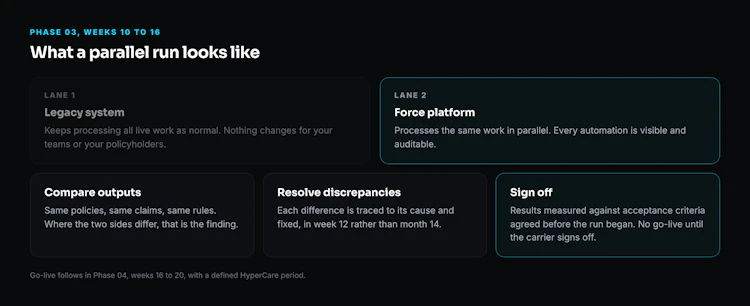
In our model it runs from week 10 to week 16, overlapping the end of the build phase. Here's what happens in each lane.
- Legacy system: Keeps processing all live work as normal. Nothing changes for your teams or your policyholders., Your operations teams
- Force platform: Processes the same work in parallel. Every automation is visible and auditable., Force engineers
- Comparison: Outputs from both sides are compared. Discrepancies are identified and resolved., Force, with your subject matter experts
- Sign-off: Results are measured against the acceptance criteria agreed before the phase began., Your team
The overlap with the build phase is deliberate. You start seeing the new system produce real output before the configuration is finished, which means problems surface while there's still time and budget to fix them.
Discrepancies aren't a sign the run is failing. They're what the run is for. A rating difference of a few dollars on one class of business is exactly the kind of thing you want to find in week 12, not in month 14 after cutover.
What are acceptance criteria and why do they come first?
Acceptance criteria (milestones) are the written definition of what "working" means for your carrier. They're agreed before the parallel run starts, not after.
That ordering matters more than it sounds. If the criteria are set during the run, every discrepancy becomes a negotiation about whether it counts. If they're set before, every discrepancy is simply measured against a standard everyone already accepted.
The criteria are specific to each carrier, because each carrier's book, rules and regulatory exposure are different. The kind of thing worth writing down:
- Which outputs must match the legacy system exactly, and which are allowed a tolerance
- Which lines, states, and transaction types are in scope for the comparison
- What volume and duration of clean processing is required before sign-off
- Who has the authority to accept, and who has the authority to stop
In our model, no go-live happens until the carrier signs off against those criteria. That's written into our implementation plan. It's the control.
What does the carrier do during a parallel run?
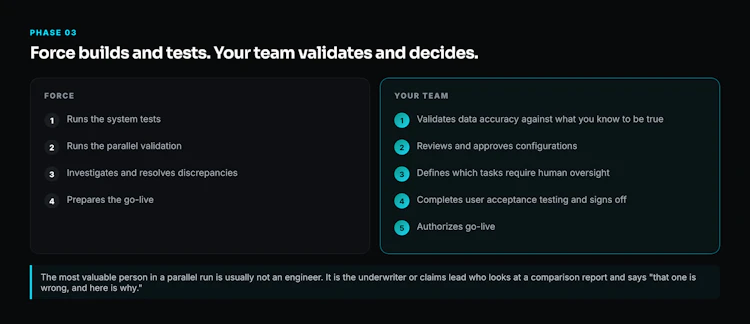
Less building than you might expect, and more deciding. Force does the work. Your team provides the knowledge and the decisions.
On our side: running the system tests, running the parallel validation, investigating and resolving discrepancies, and preparing the go-live. On your side:
- Validating data accuracy against what you know to be true
- Reviewing and approving configurations
- Defining which tasks require human oversight
- Participating in user acceptance testing and acceptance sign-off
- Authorizing go-live
The most valuable person in a parallel run is often not an engineer. It's the underwriter or claims lead who looks at a comparison report and says "that one is wrong, and here's why." That knowledge is what the run is designed to capture.
It's also why the data has to be right before the run starts. The mapping happens in Phase 01, before anything moves.
What happens at go-live and during HyperCare?
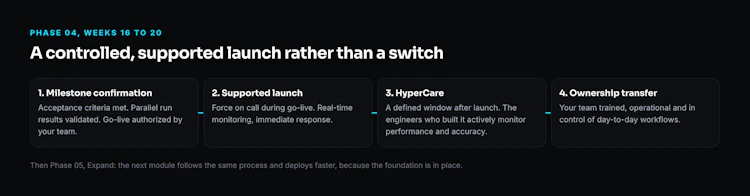
Go-live is Phase 04, weeks 16 to 20, and it's a controlled, supported launch rather than a switch.
It moves through four stages:
- Milestone confirmation. Formal acceptance criteria met. Parallel run results validated. Go-live authorization from your team.
- Supported launch. Force team on call during go-live, with real-time monitoring and immediate response to any issue.
- HyperCare period. A defined support window after launch. Force engineers actively monitor system performance and operational accuracy.
- Ownership transfer. Your team is trained, operational, and in control of day-to-day workflows.
Related: Premium Leakage: How Disconnected Systems Quietly Cost Carriers Money
HyperCare answers the question every carrier should ask: what if something goes wrong on day three? The people who built the system are still watching it. The response is immediate, not routed through a support tier.
How does a parallel run change the size of the decision?
A traditional cutover asks a leadership team to approve a decision that can't be reversed without a second program. A parallel run asks them to approve something they have already watched work, on their own book, with the old system still available if they say no.
That changes who can say yes, and how quickly. It's the difference between betting the business on a plan and confirming a result you've already seen. We explain why that step size is the real driver of modernization success in how to modernize an insurance core system without a three-year migration.
What does a parallel run have to get right?
Four things, and the method is built around each of them.
- Data quality surfaces. The parallel run can be where a carrier discovers that historical records mean something different from what the field name suggests. That's a migration problem, and it's why we map your operational logic before moving records.
- Scope drifts. A parallel run that keeps adding lines and transaction types never ends. The acceptance criteria are the fix, because they define what's in scope before you start.
- Your team runs out of bandwidth. Reviewing comparison reports takes real people with real expertise. The workload should be planned, not discovered.
- The first workflow is too big. A parallel run on one workflow is measurable. A parallel run on the entire operation at once is the old model wearing a new name.
Once the first workflow is live, the next module follows the same process and deploys faster, because the foundation is already in place. A common second step is product configuration, which we cover in no-code policy configuration.
Key takeaways
- A parallel run has the new platform and the legacy system process the same live work at the same time, with outputs compared and discrepancies resolved before anything is switched.
- The traditional single-day cutover concentrates every risk into one event, which is the shape of the project behind the 74% transformation failure rate BCG reports.
- Acceptance criteria are agreed in writing before the parallel run begins, so "ready" is measured against a standard rather than negotiated under pressure.
- The carrier validates data, approves configurations, completes acceptance testing, and authorizes go-live. Force runs the tests and resolves the discrepancies.
- Go-live is followed by a defined HyperCare period in which the engineers who built the system actively monitor it before ownership transfers to your team.
Frequently asked questions
What is a parallel run in software implementation?
A parallel run is a validation method where a new system and the existing system both process the same live transactions for a defined period. The outputs are compared to confirm the new system behaves correctly before the old one is retired. In insurance core system replacement, it's the safest way to prove rating, policy, claims and billing outputs on a carrier's real book.
How long does a parallel run take?
In our implementation model, the parallel run is Phase 03 and runs from week 10 to week 16, overlapping the end of the build phase. It continues until both sides confirm readiness against the acceptance criteria. The overall timeline is 3 to 6 months to first workflow live.
What is HyperCare after go-live?
HyperCare is a defined support window immediately after a system launches. During it, the engineers who built the system actively monitor performance and operational accuracy and respond immediately to any issue. It ends when the carrier's team has taken ownership of day-to-day operations.
Related: Multi-Tenant vs Dedicated Environments for Insurance Software
Who decides when to go live?
The carrier does. In our model, go-live requires the formal acceptance criteria to be met, the parallel run results to be validated, and go-live authorization from the carrier's team. There's no go-live until the carrier signs off.
Final thoughts
The riskiest part of a core system replacement has never been the software. It has been the day you find out whether the software was right.
A parallel run moves that discovery from production into a controlled period where the old system is still doing its job and nothing depends on the new one yet.
Set the acceptance criteria first, keep the first workflow small, and put your best operators on the comparison reports. That's where the value is.
Then go live on a decision you've already seen the answer to.
See what Force does with your operations
We run every implementation through the same five phases, and the parallel run is the one that earns the go-live.
Book a demo of Force and we'll walk you through what validation would look like on your book.