AI Claims Processing: Fraud Detection, Inspections, and Reserves Explained
AI claims processing reads the photos, video, and inspection documents on a claim. It compares what was claimed against what the evidence shows.
It flags the mismatches that suggest fraud. Then it recommends a reserve and a reinsurance position for the adjuster to approve.
So what's left for the adjuster? The decision. What changes is how much of the file has been read, checked, and structured before they open it.
Here's what each part does, where the savings come from, and what stays with the person.
Three jobs on every claim
Three jobs, in sequence, on every claim it touches.
Inspections. Force's AI agent, InspectForce, analyzes the images, video, and inspection documents attached to the claim. (These are uploaded by the policyholder, as opposed to an inspector visiting sites in-person, saving huge amounts of time and money.) It identifies the damage, the scope, and the inconsistencies, and produces a structured summary the adjuster can work from. What used to require a site visit or a desk review of thirty photographs is prepared before the file is opened.
Fraud detection. It compares the claim to the inspection evidence. The claimed damage against the photographed damage. The stated cause against what the images show. The timeline against the metadata. Mismatches are flagged with the reason, so the adjuster sees not only "this looks wrong" but what specifically doesn't line up.
Reserves and reinsurance. Based on the verified scope, it recommends a reserve and, where the claim implicates a treaty, the reinsurance position. The recommendation is visible with its reasoning. The adjuster approves, adjusts, or overrides.
In our platform that's one agent, InspectForce: visual AI for inspections and claims. It analyzes photos, detects fraud, and recommends reserves. Across the platform we've seen a 50% cost reduction in inspections and loss adjustment expenses.
How big the fraud problem is
Large enough that the most comprehensive study put it in the hundreds of billions.
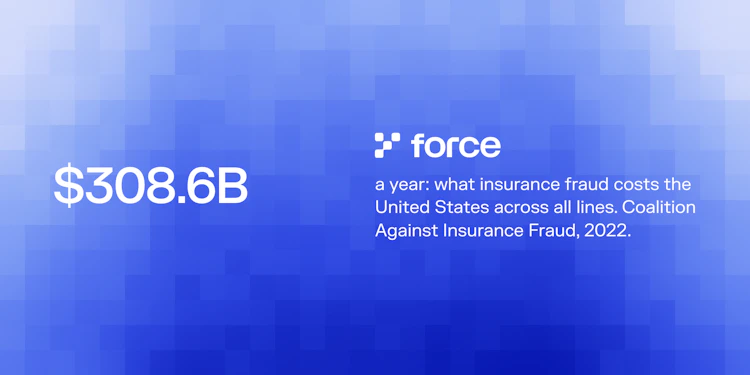
The Coalition Against Insurance Fraud's 2022 study estimated that insurance fraud costs the United States $308.6 billion a year across all lines. The analysis was conducted by Colorado State University Global's White Collar Crime Task Force. The same report cites the Insurance Information Institute's long-standing estimate that fraud accounts for about 10% of the property and casualty industry's incurred losses and loss adjustment expenses each year.
Two things follow for a claims operation. First, fraud isn't an edge case. At roughly a tenth of losses, it's a line item.
Second, the detection has to happen inside the normal claims workflow rather than in a separate investigation unit that only sees the claims someone thought to refer.
Claim-to-inspection comparison on every file is how routine claims get checked, not only the suspicious ones.
How visual AI reads an inspection
By treating the photographs and documents as evidence to be analyzed rather than attachments to be opened.
A property claim arrives with photographs from the policyholder, sometimes video, sometimes a contractor's estimate, and eventually an inspection report. Today an adjuster reviews each item, forms a view of the scope, and reconciles it against the estimate by hand.
Visual AI does the review first. It identifies what's in the images: the type of damage, the affected areas, the visible extent. It reads the inspection documents and the estimate and extracts the line items.
It puts those side by side and marks where they agree and where they don't. The adjuster opens a file with the scope already structured and the discrepancies already listed.
The comparison is the fraud control. A claim for water damage across three rooms with photographs showing one. An estimate that includes replacement of items not visible in any image. A timeline in the narrative that the image metadata doesn't support.
Each one is a flag with a reason attached, and the adjuster decides what to do with it.
What the adjuster decides
Everything that matters. The agent prepares and recommends. The person approves.
- Analyzes images, video, and inspection documents: Reviews the structured summary and the flagged discrepancies
- Compares the claim to the evidence and flags mismatches: Decides whether a mismatch is fraud, error or explanation needed
- Recommends a reserve based on verified scope: Approves, adjusts or overrides the reserve, with the reason on the record
- Recommends a reinsurance position where a treaty applies: Confirms the cession and the recovery
- Logs every step with its reasoning: Handles the conversation with the policyholder, the contractor and the SIU
This is the model across our platform: AI recommends, humans decide. Every recommendation carries an audit trail with detailed node results. The workflow shows a visual step and approval flow.
The adjuster can see what the agent found, what rule it applied, and why it recommended what it did. Claims teams move faster with InspectForce AI-assisted workflows because the reading is done, not because the judgment is removed.
This is the model across our platform: AI recommends, humans decide.
Where the 50% comes from
From inspections that no longer require a visit, and adjustment work that no longer starts from an unread file.
Loss adjustment expense is the cost of handling the claim: the adjuster's time, the inspection, the expert reports, the back and forth. Two of the largest components are the physical inspection and the desk time spent reading and reconciling the file. Visual AI reduces both.
Many inspections can be completed from the evidence already on the claim. Desk time starts from a structured summary rather than a folder of attachments.
The 50% figure is the cost reduction in inspections and loss adjustment expenses we've seen across the platform. The mix of claims varies by carrier and by line. It's what the workflow change produces when the reading, the comparison and the first recommendation are done by the agent.
The reserving side has a second effect that shows up in the loss ratio rather than the expense ratio. When the reinsurance recommendation is generated at the moment the claim is verified, rather than reconstructed at quarter-end, cessions and recoveries stop depending on someone noticing.
What changes for the policyholder
It shortens the wait, and it removes the part where they have to ask three times.
The J.D. Power 2025 U.S. Claims Digital Experience Study is based on 5,958 evaluations from auto and homeowners customers who had completed a claim. Among customers who rated their digital claims experience poorly, 52% were likely to leave or not renew with their carrier. Among those who rated it excellent, 4%.
Related: Conversational AI for Policyholders: Cut Call Volume Without Losing Service
Adequate digital status updates ranked as a top satisfaction driver, yet insurers delivered them just 22% of the time. Only 36% of auto customers and 31% of home customers received status updates through the app, and 22% of customers relied on multiple channels to get an answer to the same question.
A claim that has been read, verified, and reserved by the agent on day one is a claim that can be updated on day one. The status is real because the work is done. Where the policyholder wants to ask a question, the same verified claim data is what our AssistForce agent answers from, which we cover in conversational AI for policyholders.

Fairness and flagged claims
A flag is a reason to look, not a decision to deny. The governance keeps it that way.
Every flag InspectForce raises carries the specific discrepancy that triggered it, so the adjuster is evaluating evidence rather than a score. Approval limits, escalation triggers, and routing are configured by the carrier: a flagged claim above a threshold goes to a senior adjuster or the SIU, and the record shows why. The timing of human review is tracked.
Schema masking keeps personal bias data from reaching the model, and output auditing is configurable so the distribution of flags and reserves across segments can be reviewed. The same role-based access controls apply to the agent as to a person: it sees the claim data its task needs, and no more.
This is the governance a regulator expects. It's why we built claims AI as one of three levels of intelligence in a single governed system, rather than as a standalone fraud tool. We explain the three levels in the three levels of software intelligence in insurance.
A flag is a reason to look, not a decision to deny.
How to start
With one line, the existing evidence, and the adjusters in the room.
- Pick the line where inspections cost the most. Property is the usual answer, because the evidence is visual and the inspection is expensive.
- Run the agent on closed claims first. Compare what it would have flagged and reserved against what actually happened. That's the fastest way to calibrate trust.
- Set the escalation thresholds with the adjusters. They know which discrepancies matter. The configuration should reflect that.
- Measure inspection cost and adjuster desk time separately. Both should move, and they move for different reasons.
- Connect the reserving to reinsurance from the start. The recovery that gets generated at verification is the one that doesn't leak.
InspectForce runs in your own dedicated environment, on top of the claims systems you already have. It's one of seven agents that share an intelligence layer, which we describe in AI agents for insurance companies. The wider picture of how claims AI fits with underwriting, policy and service is in AI for insurance carriers: the complete guide.
Key takeaways
- AI claims processing analyzes photos, video, and inspection documents, compares the claim to the evidence to detect fraud, and recommends reserves and reinsurance positions. The adjuster approves every decision.
- The Coalition Against Insurance Fraud puts insurance fraud at $308.6 billion a year in the US across all lines, and cites the Insurance Information Institute's estimate that fraud is about 10% of P&C incurred losses and loss adjustment expenses.
- The 50% cost reduction in inspections and loss adjustment expenses comes from inspections completed from existing evidence and adjustment work that starts from a structured, verified file.
- Poor digital claims experiences drive 52% of customers to consider leaving, per J.D. Power. A claim verified on day one is a claim that can be updated on day one.
- Every flag carries its reason, thresholds are set by the carrier, and human review is tracked; a flag is a reason to look rather than a decision to deny.
Frequently asked questions
What is AI claims processing?
It's the use of AI, mainly visual AI, to analyze the images, video, and documents on an insurance claim, compare what was claimed to what the evidence shows, flag discrepancies that may indicate fraud, and recommend a reserve and reinsurance position. The adjuster reviews the structured output and makes the decisions.
How does AI detect insurance claims fraud?
By comparing the claim to the inspection evidence. The AI identifies the damage visible in photos and video, extracts the line items from estimates and inspection reports, and flags where the claimed scope, cause or timeline doesn't match the evidence. Each flag carries the specific discrepancy, and the adjuster decides whether it's fraud, error, or something that needs explaining.
Related: What Is a Parallel Run? The Safest Way to Go Live on a New Insurance Platform
Does AI set claims reserves?
It recommends them. Based on the verified scope of the claim, the AI proposes a reserve and, where a reinsurance treaty applies, a reinsurance position, with the reasoning visible. The adjuster approves, adjusts or overrides, and the decision and its timing are on the audit trail.
How much does AI reduce loss adjustment expenses?
Across our platform we've seen a 50% cost reduction in inspections and loss adjustment expenses. The savings come from inspections completed from existing evidence rather than site visits, and from adjuster desk time that starts with a structured, verified file instead of unread attachments.
Final thoughts
The claims file has always contained the evidence. What it lacked was someone with time to read all of it, on every claim, before forming a view.
Visual AI is that reader. It puts the claim beside the evidence, marks where they disagree, and proposes a reserve, all before the adjuster opens the file.
The adjuster still decides. The difference is what they're deciding from.
Read every claim. Flag with reasons. Keep the decision human and on the record.
The adjuster still decides. The difference is what they're deciding from.
See it on your own operations
InspectForce reads the photos, compares them to the claim, and recommends the reserve. Your adjusters decide.
Book a demo of Force and bring a closed claim you already know the answer to.