AI Agents in Insurance: What They Actually Do (7 Real Examples)
Every vendor now sells what they call "AI agents." So what does one actually do?
An AI agent in insurance takes on one carrier workflow and runs it. Configuring a product. Reading a policy manual. Verifying a claim. Answering a policyholder.
It works under the carrier's own rules, with a full audit trail, and it does the work rather than describing it.
Below are the seven agents we built, one per workflow: what each does, what it needs from you, and how they fit together. First, why the word "agent" has become hard to trust.
What an AI agent actually does
They take a workflow the carrier already runs and execute it, inside the carrier's environment, under the carrier's rules, with every decision logged.
That's different from a chatbot, which simply answers questions.
It's also different from a model, which produces predictions.
An agent acts. It reads the inputs, applies the business rules it has been configured with, moves the work forward, and records what it decided and on what basis. A human sets the boundaries and approves what needs approving.
The reason to be precise about the definition is that the word is being stretched. In June 2025, Gartner predicted that over 40% of agentic AI projects will be canceled by the end of 2027, and pointed at a practice it called "agent washing."
That's where existing products such as AI assistants, robotic process automation, and chatbots are rebranded as agents without substantial agentic capabilities. A carrier that buys one of those gets a chatbot with a new name.
For a carrier, the useful test is narrow. Does it do a job you currently pay people to do? Does it run in your environment, on your data?
Can you see why it did what it did? If the answer to any of those is no, it isn't an agent. It's a feature.
The seven Force agents
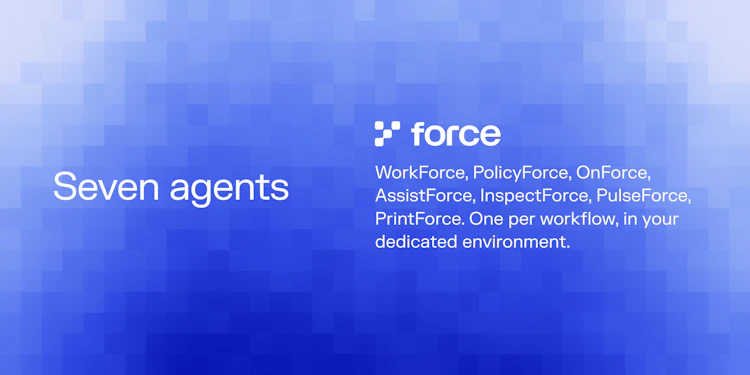
Each agent addresses a specific carrier workflow. All of them operate in your own dedicated environment and share one intelligence layer, which means what one agent learns about your operation is available to the others. Here they are:
1. WorkForce: policy lifecycle workflow orchestration
What it does: runs the policy lifecycle from quote to renewal as a no-code workflow, with rules and triggers you set. It automates the handoffs between steps, applies the routing and approval rules your team defines, and gives real-time visibility into execution paths and bottlenecks.
What it needs from you: your workflow logic, your approval rules, and a decision about which steps require human oversight.
Why it matters: most of the friction in a carrier isn't in any one task. It's in the gaps between tasks, where work waits for someone to notice it. WorkForce is the agent that closes those gaps, and it's the first one we deploy, alongside PolicyForce.
2. PolicyForce: no-code policy product configuration
What it does: lets business users build and manage products without engineering. It's natural-language guided, so a product owner describes what the product needs to do and the configuration is built from that. It covers rating rules, endorsements, and lifecycle management.
Business users own the full product lifecycle.
What it needs from you: the product definition, the rating logic you already have, and sign-off from whoever owns the product. The rating algorithms remain the carrier's responsibility.
Why it matters: in many carriers, product changes queue with engineering, which must make code changes (which themselves can cause problems with your previous customizations). PolicyForce moves the product back to the people who own it, with every change logged and subject to your approval thresholds.
3. OnForce: automated onboarding and policy interpretation
What it does: turns policy manuals into working configurations. It reads and interprets carrier policy documents, extracts rating variables, eligibility rules, and regulatory requirements, and generates validated, ready-to-deploy configurations. Weeks of onboarding work, done in days.
What it needs from you: the documents. Rating manuals, product guides, operational procedures. The knowledge that's currently in binders and in the heads of experienced staff.
Why it matters: the slowest part of any implementation or product launch is recovering the logic nobody wrote down in a form a system can read. OnForce is the agent that does the reading.
4. AssistForce: conversational AI for policyholders and staff
What it does: gives natural-language access to policy, claims and billing information, for policyholders and for your own teams. Coverage explanations are aligned to your underwriting rules, so the answer to "am I covered for this?" is your answer, not a generic one. It provides self-service capability that dramatically reduces call center volume.
What it needs from you: your policy data, your coverage rules, and a decision about what it may answer and what it should hand to a person.
Why it matters: customer service scales without sacrificing experience. The calls that remain are the ones that need a human.
5. InspectForce: AI-driven inspection and claims verification
What it does: visual AI for inspections and claims. No more need for multiple full-time employees driving around from site to site taking pictures. Instead, the policyholder uploads a photo. InspectForce then analyzes the images, video and inspection documents, detects fraud through claim-to-inspection comparison, and produces automated reserve and reinsurance recommendations.
What it needs from you: the claim file, the inspection evidence, and the reserving and reinsurance rules it should recommend against. The adjuster decides. The agent recommends.
Why it matters: this is where the cost reduction is largest. Across the platform we've seen a 50% cost reduction in inspections and loss adjustment expenses. We go deeper on how the claims workflow changes in AI claims processing.
6. PulseForce: analytics and decision support
What it does: turns carrier data into operational analytics and decision support. Loss ratio trends, retention analysis, and pricing optimization. Market-responsive adjustments made under governance controls your team sets. Executive dashboards with risk and opportunity signals.
What it needs from you: the governance controls. What it may adjust, within what limits, and who approves.
Why it matters: leadership gains clear, real-time visibility with custom reporting, on data that hasn't waited for an overnight batch.
7. PrintForce: automated printing and mailing
What it does: insurance requires physical mail: policy documents, notices, compliance mailings. PrintForce replaces that printing and mailing operation inside your governed environment. Document generation is triggered across policy, billing and claims. It works standalone or within WorkForce, is built on proven service providers, and adapts formatting, templates, and branding to each carrier automatically.
What it needs from you: your templates and your branding. No manual configuration after that.
Why it matters: print and mail is the workflow nobody wants to modernize and everybody still pays for. PrintForce deploys independently, alongside any other agent, which makes it a low-risk first step for a carrier that wants to see an agent work before committing further.
One intelligence layer
Through one intelligence layer, in one environment; context carries across the lifecycle instead of resetting at every functional boundary.
That's the difference between agents and a collection of point tools. A point tool for claims doesn't know what underwriting decided. A point tool for underwriting doesn't know a claim was just verified.
When the agents share an intelligence layer, the reserve InspectForce recommends can reflect the reinsurance position PolicyForce configured. The coverage explanation AssistForce gives reflects the rules that actually apply to that policy.
The layer learns your operations and sharpens with every interaction. Meanwhile, we never train on your data. The intelligence accumulates in your own configurations and retrieval, and compounds with use.
AI models are interchangeable. The intelligence layer isn't.
This is also what lets our platform support all three levels of intelligence, rules-based automation, machine learning, and generative and agentic AI, in one integrated system rather than as separate integrations. We explain these three levels in the three levels of software intelligence in insurance.
AI models are interchangeable. The intelligence layer isn't.

What deployment takes
Less than a platform replacement, which is the point.
Our microservices and agents run in your own dedicated, isolated environment from day one: your own database, your own agents, your own security boundary, configured for your business rules. They deploy on top of the tech systems you already run. Nothing has to be ripped out to make room for them (though it's still clear that eventually, moving to a modern core system like Force's will be the modernization step carriers need to make).
What a carrier provides, in practice:
- The workflow knowledge: manuals, procedures, rules, and the people who know the exceptions
- The governance decisions: which tasks require human oversight, what the approval thresholds are, who can escalate
- The sign-off: configurations are reviewed and approved by your team before anything runs live
What we provide: the environment, the agents, the configuration, the integration to your existing systems, and direct access to the engineers doing the work.
Every agent action is logged with complete traceability: who decided what, when, and why. Agent decisions are documented and inspectable, so compliance and regulators can review what each agent does and on what data.
Your team defines approval limits, escalation triggers, and routing, and those business rules are enforced at the agent layer. Traceability, auditability, and governance are designed in from the start rather than added after the fact.
Where to start
With the workflow that costs the most, and with one microservice or agent rather than seven.
For many carriers that's product configuration, because every legacy tech rate change now is queued behind engineering. PolicyForce and WorkForce are the pair we typically deploy first, because together they cover the product and the lifecycle.
For a carrier whose pain is in claims, InspectForce is the starting point. The lifecycle workflow, where a policy needs too many hands, has its own guide in policy lifecycle automation from quote to renewal.
Microservices and agents are the on-ramp. Give us a problem, we fix it with modern, customizable microservices, and you grow into the platform if and when you want to.
They run in the same environment the full platform runs in, so the first microservice or agent is the beginning of a new core rather than a layer bolted onto the old one. A carrier can stop at one, or add the suite, or move to the full connected platform, on its own timeline.
That sequence runs from agents acting on your existing systems to a platform that becomes the system. It's what we mean by moving from a system of record to a system of action, which we set out in the new enterprise stack.
Microservices and agents are the on-ramp. Give us a problem, we fix it with modern, customizable microservices, and you grow into the platform if and when you want to.
Five questions that separate an agent from agent washing
Five questions. A genuine agent answers all of them.
- Does it execute a workflow, or answer questions about one? An agent moves the work. An assistant describes it.
- Does it run in your environment, on your data? If your data leaves your boundary to be processed, you have a service (and a risky, slow, expensive one at that), not an agent.
- Does it apply your rules, or generic ones? Coverage explanations aligned to your underwriting rules are an agent. A general-purpose model guessing at coverage is a liability.
- Can you see why it did what it did? Every decision logged, every action traceable. If not, it's a black box with a friendly name.
- Is there a path from this agent to the next one? Point solutions with no governance trail and no route to a connected platform are the "one time data pulls" carriers have already tried.
What carriers actually need, in our view: microservices and agents built for real carrier operations, data that's unified in one place and actions that are fully governed, and a clear path from microservices and agents to a full platform. The complete picture of how AI fits across a carrier, from rules to agents to platform, is in AI for insurance carriers: the complete guide.
Key takeaways
- An AI agent in insurance executes one specific carrier workflow, in the carrier's own environment, under the carrier's rules, with every decision logged. It acts rather than answers.
- Gartner predicts over 40% of agentic AI projects will be canceled by the end of 2027, and names "agent washing" as a cause. The test for a carrier is whether the software does a job people are currently paid to do.
Related: What Is a Parallel Run? The Safest Way to Go Live on a New Insurance Platform
- Force runs seven agents, one per workflow: WorkForce, PolicyForce, OnForce, AssistForce, InspectForce, PulseForce and PrintForce, sharing one intelligence layer in a dedicated environment.
- Agents deploy on top of the systems a carrier already runs. Nothing is replaced to start, and the first microservice or agent is the on-ramp to the platform rather than a bolt-on.
- Every agent action is traceable, human oversight is configurable per task, and Force never trains on carrier data.
Frequently asked questions
What is an AI agent in insurance?
It's software that takes on a specific carrier workflow, such as product configuration, document interpretation, claims verification or policyholder service, and executes it under the carrier's own business rules with a full audit trail. Unlike a chatbot, it does the work rather than describing it, and unlike a predictive model, it acts on the prediction within boundaries a human has set.
How many AI agents does Force have?
Seven. WorkForce for policy lifecycle orchestration, PolicyForce for no-code product configuration, OnForce for automated onboarding and policy interpretation, AssistForce for conversational AI, InspectForce for inspection and claims verification, PulseForce for analytics and decision support, and PrintForce for automated printing and mailing. They share one intelligence layer in the carrier's dedicated environment.
Do we need to replace our core system to use AI agents?
No. The agents run in your own dedicated environment from day one, on top of the carrier systems you already have. The starting point we recommend is one modern microservice or agent on the workflow that costs you most. The full connected platform is where that can lead, on your timeline, not a prerequisite.
Are AI agent decisions auditable?
Yes. Every agent action is logged with who decided what, when and why. Agent decisions are documented and inspectable so compliance and regulators can review what each agent did and on what data. Approval limits, escalation triggers, and routing are set by the carrier's team and enforced at the agent layer.
Final thoughts
The word agent is doing a lot of work in vendor decks right now. Most of it is agent washing, and Gartner expects a large share of those projects to be canceled.
The version that survives is narrow and specific: one workflow, one environment, your rules, full traceability.
Seven of those, sharing what they learn, is a platform. One of them, on the workflow that hurts most, is a start.
Start there.
Seven of those, sharing what they learn, is a platform. One of them, on the workflow that hurts most, is a start.
See it on your own operations
One platform. Seven agents. Your environment. We'll show you the one that fits the workflow costing you most.
Book a demo of Force and bring the process your team would most like to stop doing by hand.