Policy Lifecycle Automation: From Quote to Renewal Without the Handoffs
Why does a policy still need six people to touch it?
Not because any one step is hard. Because the steps live in different systems, and between every two of them someone has to notice the work is waiting, pick it up, re-key it and pass it on.
Policy lifecycle automation removes those handoffs.
The work moves itself, under rules you set, and people handle the exceptions. Here's what that looks like from quote to renewal.
What lifecycle automation changes
Policy lifecycle management is everything that happens to a policy between the first quote and its renewal or cancellation. Quote, bind, issue, endorse, bill, renew, cancel.
Every carrier does all of it. Many do it across several systems, with people carrying the work between them.
Automating the lifecycle changes one thing: who moves the work. Instead of a person noticing that a bound policy needs issuing, the workflow moves it.
Instead of an underwriter forwarding an endorsement to billing, the rule does. Instead of someone building a spreadsheet to see what's stuck, the system shows you.
What it doesn't change is who decides. Approvals, exceptions, and anything outside the rules you set still go to a person.
The handoffs go away. The judgment stays.
The handoffs go away. The judgment stays.
Where the handoffs come from
From fragmentation: Most carriers run separate tools for underwriting, claims, billing, reporting, agent and policy admin. None of them were designed to work together.
Every boundary between two of those tools is a handoff. Someone has to carry the policy across it.
That's where the duplicated work, the re-keying, and the waiting come from, and it's where the visibility goes. Leadership can't see what's happening across the business, because the business is spread across six screens.
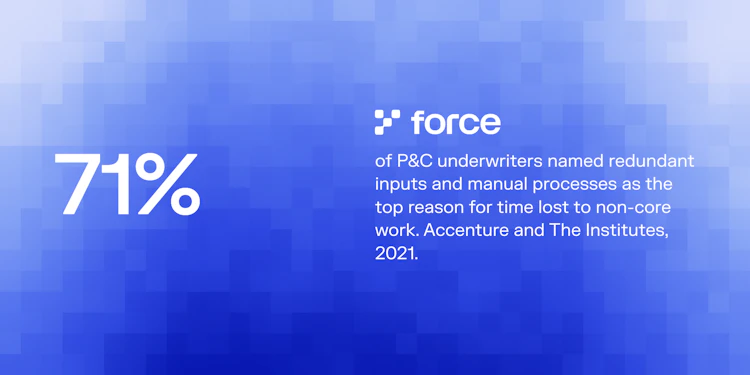
The cost shows up in the surveys. In the 2021 Accenture and The Institutes survey of 434 P&C underwriters, the top reason given for time lost to non-core work was redundant inputs and manual processes, cited by 71%.
In Capgemini's 2024 survey of 3,323 policyholders, 42% said they find the underwriting process complex and lengthy. Both are describing the same handoffs from opposite ends.

Quote to renewal, stage by stage
Here's the path, with what moves automatically and what stops for a person.
- Quote: Routes the submission, applies your eligibility rules, flags what's missing, Anything outside appetite or authority
- Bind: Confirms conditions are met, triggers issuance, Exceptions to bind conditions
- Issue: Generates the documents, updates billing, notifies the agent, Nothing, if the rules pass
- Endorse: Applies the change, re-rates, updates billing and reinsurance position, Changes above your approval threshold
- Bill: Schedules and issues invoices, tracks payment status, Disputes and non-payment escalations
- Renew: Prepares the renewal from current data, applies renewal rules, routes, Re-underwriting decisions, retention calls
- Cancel: Processes the request, calculates return premium, closes out, Retention intervention, if your rules ask for it
Notice the pattern. Routine work runs in the background.
People focus on what matters. That's the design principle behind everything we build, and the lifecycle is where it shows most clearly.
Who owns the workflow
Your team owns it, and no code is involved.
Our WorkForce agent orchestrates the policy lifecycle from quote to renewal as a no-code workflow with your rules and triggers. A trigger is an event: a quote is bound, an endorsement is requested, a renewal date is 60 days out. A rule is what happens next: route here, require this approval, notify that person, update that system.
Because it's handled with configurations rather than code, your operations team can adjust rules, thresholds, and workflows without developer dependency. When your approval limit changes, you change it. When a new line needs a different renewal path, you add it.
Every automation, rule, and workflow is visible in the platform. No logic hidden in code.
That matters for two reasons: Your team can see and change what the workflow does. And your compliance team can see what it did.
Seeing what's stuck
In real time, without building a report.
WorkForce gives real-time visibility into execution paths and bottlenecks. Every policy in the lifecycle has a position and a history. You can see how many are waiting at each stage, how long they've been there, and which rule or which person they're waiting on.
That replaces the spreadsheet somebody maintains to track what's in flight. It also changes the conversation with leadership. Instead of "we think renewals are slow," you have "renewals wait an average of this long at underwriting review, and here are the ones over the threshold."
Leadership gains clear, real-time visibility with custom reporting. That's the promise of one connected system, and the lifecycle is the first place carriers feel it.
The rules nobody wrote down
They get written down. That's the hardest part of the work, and it's where much of the value is.
In many carriers, the lifecycle runs on rules that exist only in practice. The senior underwriter knows which brokers get a call before a decline. Billing knows which accounts get an extra week.
Related: AI Governance in Insurance: Audit Trails, Visible Logic and What Regulators Expect
Nobody documented it, because nobody had to. The people carrying the work between systems carried the rules with them.
When the workflow moves the work instead, those rules have to be explicit. That's uncomfortable for about a week, and then it's the first time the carrier has had a complete picture of how it actually operates. We wrote about this in the invisible logic of insurance.
How it connects to product and claims
Through the same configuration and the same environment.
The lifecycle runs on the product. The rating rules, endorsements and eligibility conditions the workflow applies are the ones your product team configured, which is what no-code policy configuration is about.
Change the product and the lifecycle picks up the change. No release, no retest.
The lifecycle also feeds claims. A claim that's verified is visible to the renewal workflow at the moment it's verified, not after an overnight batch.
That's the difference between renewing on last month's picture of the risk and renewing on today's. It's why we treat AI claims processing as part of the same connected system rather than a separate tool.
WorkForce is one of seven agents that share an intelligence layer in your dedicated environment. The full set is in AI agents in insurance: what they actually do.
Does this mean fewer people?
No. It means the same people doing different, more profitable work.
Underwriters focus on judgment, not repetitive processing. Claims teams move faster with AI-assisted workflows.
Customer service scales without sacrificing experience. That's what we mean by elevate teams, not replace them.
The handoffs weren't anyone's job. They were the tax every job paid. Remove them and the underwriter is underwriting, the billing specialist is resolving disputes rather than re-keying invoices, and the operations lead is managing exceptions rather than chasing status.
The handoffs weren't anyone's job. They were the tax every job paid.
How to start
With one line and one stage.
- Map the lifecycle for one line of business as it actually runs. Every handoff, every system, every person. The map will surprise you.
- Pick the stage with the longest wait. Usually endorsements or renewals. That's where the first workflow goes.
- Write down the rules, including the ones that only exist in practice.
Related: What Is a Parallel Run? The Safest Way to Go Live on a New Insurance Platform
- Set the approval thresholds conservatively. Route more to people than you think you need to. Widen the automated path as the record earns trust.
- Measure the wait time at that stage before and after. That's the number that should move.
WorkForce deploys in your own environment, on top of the systems you run today. It's one of the two agents we deploy first, alongside PolicyForce, because together they cover the product and the lifecycle. The wider picture of how AI fits across a carrier is in AI for insurance carriers: the complete guide.

Key takeaways
- Policy lifecycle management covers everything from quote to renewal or cancellation. The handoffs between stages, not the stages themselves, are where the time and the errors go.
- Lifecycle automation changes who moves the work, not who decides. Routine steps run on rules and triggers. Exceptions and approvals go to people.
- Redundant inputs and manual processes were the top reason underwriters gave for lost time, cited by 71% in the 2021 Accenture and The Institutes survey.
- The workflow is no-code, owned by your operations team, and visible in full. Real-time visibility into execution paths replaces the spreadsheet that tracks what's stuck.
- The rules nobody wrote down have to be written down. That's the hardest part and the most valuable.
Frequently asked questions
What is policy lifecycle management in insurance?
It's the end-to-end handling of a policy from first quote through bind, issue, endorsement, billing and renewal or cancellation. In many carriers it runs across several systems with people manually carrying the work between them. Policy lifecycle management is the practice of making that flow reliable, visible and fast.
What is policy lifecycle automation?
It's the use of a rules-based workflow to move a policy through its lifecycle without manual handoffs. Triggers such as "quote bound" or "renewal due in 60 days" fire rules that route work, apply the carrier's product logic, update billing and reinsurance, and send exceptions to a person. The carrier's team configures the rules without code.
Does automating the policy lifecycle remove human review?
No. The carrier defines which steps require human oversight and sets approval thresholds and escalation triggers. Anything outside those rules goes to a person, with the reason visible on the file. What's removed is the handoff work between steps, not the decisions.
Can policy lifecycle automation run on an existing core system?
Yes. Our WorkForce agent runs in the carrier's own dedicated environment on top of the systems already in place. It's typically one of the first two agents deployed, alongside PolicyForce for product configuration. The full connected platform is an option for later, not a requirement to start.
Final thoughts
A policy needs six people to touch it because six systems need a person to connect them.
Automate the lifecycle and the work moves itself, under rules your team wrote and can see. The people are still there. They're doing the parts that need them.
Start with one line and the stage with the longest wait. Write down the rules. Measure the wait.
Then watch what your underwriters do with the time.
Start with one line and the stage with the longest wait. Write down the rules. Measure the wait.
See it on your own operations
WorkForce runs your policy lifecycle from quote to renewal, on rules you own, with every step visible.
Book a demo of Force and bring the stage where policies wait the longest.