No-Code Policy Configuration: Launch Insurance Products Without Engineers
A policy administration system is the software a carrier uses to quote, bind, issue, endorse, renew and cancel policies. It's where your products live. In many carriers it's also where product changes go to wait (or die), because every rate revision and every new endorsement needs a developer.
No-code policy configuration changes that: business users build and manage products directly, with rating rules and endorsements as settings rather than code. Here's how that works and what to ask before you buy it.
What is no-code policy configuration in a policy administration system?
No-code policy configuration is the ability for business users to build and change insurance products inside the policy administration system through settings rather than code. Rating rules, endorsements, eligibility conditions, and lifecycle stages become configuration that a product manager or underwriting lead owns, so a product change no longer needs a developer, a release, or a retest.
That's what lets a carrier launch products without engineers. The logic still lives in the PAS. What changes is who can touch it, and how safely: every change is visible, logged, and subject to the approval thresholds the carrier sets.
In our platform this is the job of an agent called PolicyForce, which we describe below. First, the system it operates on.
What is a policy administration system?
A policy administration system (PAS) is the core record of every policy a carrier writes. It holds the product definitions, the rating rules, the forms and endorsements, and the lifecycle of each policy from quote to renewal or cancellation.
Everything else in a carrier depends on it. Billing needs the premium the PAS calculated. Claims need the coverage the PAS issued.
Reporting needs the exposure the PAS holds. Agents and policyholders see the front end of it every time they get a quote.
That's why the PAS is usually the system with the deepest embedded logic, and why replacing or modernizing it is treated as the hardest part of any core project. The rating algorithms, the eligibility rules, the state-by-state variations and the exception handling have all been layered into it over years.
A modern PAS separates that logic from the code that runs it, so the people who own the product can change the product.
Why do product changes queue behind engineering?
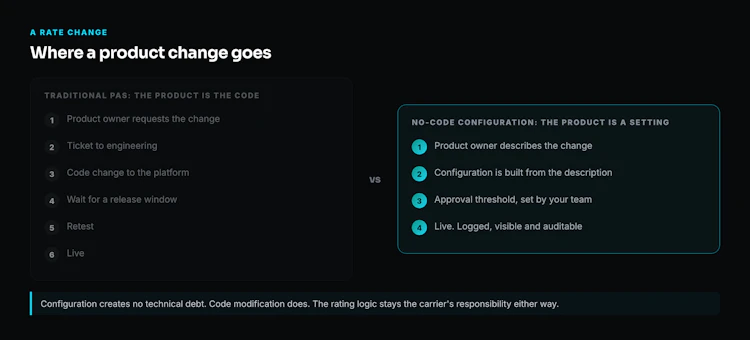
Because in a traditional PAS, the product is the code. A rate change is a code change. A new endorsement is a code change. Each one needs a developer, a release, and a retest.
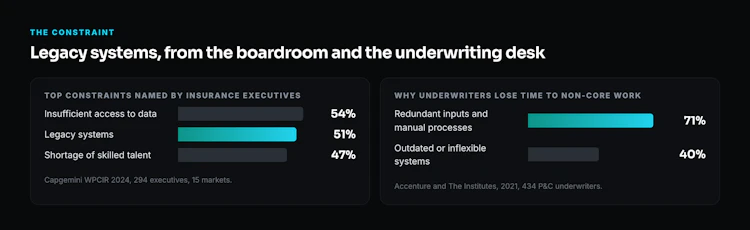
The consequences show up in the numbers. Capgemini surveyed 294 insurance executives across 15 markets in 2024. 51% named legacy systems as a top constraint on the business. Insufficient access to data (54%) and a shortage of skilled talent (47%) were the other two.
The 2021 Accenture and The Institutes survey asked 434 P&C underwriters why they lose time to non-core work. The top reasons were redundant inputs and manual processes (71%) and outdated or inflexible systems (40%).
Inside a carrier, that looks like:
- A product manager who knows exactly what needs to change and can't make the change
- A queue of rate revisions waiting on a release window
- Competitors responding to the market in weeks while your change is scheduled for next quarter, next year, or worse
- Underwriters building workarounds in spreadsheets because the system can't express the rule
Legacy systems slow product launches and market response. Teams lose time that could be spent managing risk and growing the business.
What is the difference between configuration and code modification?
This is the question that decides whether a PAS will still be workable in five years.
Configuration means changing what the system does by changing settings the business owns: a rate table, a rule, a form, a workflow. Code modification means changing the software itself. The distinction matters because configurations don't create technical debt and code modifications do.
Our own guidance to carriers evaluating vendors puts it this way: configurations are what enable you to customize your systems and launch products faster while not creating technical debt with code modifications. If a vendor's "configurable" only covers cosmetic settings, and anything real needs their engineers, you'll end up designing your operations around their system rather than the reverse.
Related: Multi-Tenant vs Dedicated Environments for Insurance Software
Two things to check in any demo:
- Can your business user make a real product change end to end? Not a label. A rating rule, an endorsement, an eligibility condition.
- Does that change touch the core platform code? If it does, every future upgrade becomes a retest of your own business.
The architecture underneath determines the answer. It's the same reason a dedicated environment matters, which we cover in multi-tenant vs dedicated environments for insurance software.
What does no-code policy configuration look like in practice?
In our platform it's an agent called PolicyForce. It's natural-language guided, which means a product owner describes what the product needs to do and the configuration is built from that description, rather than being written by hand.
What it covers:
- Rating rules. Base rates, factors, tiers, and modifiers as configured settings.
- Endorsements. Added, changed, and versioned by the business, not by a release.
- Lifecycle management. Quote, bind, issue, endorse, renew, and cancel, with the rules for each stage owned by the people who set them.
The principle behind it is simple: business users own the full product lifecycle.
Our implementation plan describes the platform as configurable by your team, with every automation, rule and workflow visible in the platform. No logic hidden in code.
Alongside it, our WorkForce agent handles the workflow side. It's a no-code workflow with rules and triggers that automates the full policy lifecycle from quote to renewal. You get real-time visibility into execution paths and bottlenecks.
Who owns the rating logic when business users configure products?
The carrier does. This matters for regulators as much as for operations.
When we configure a product, the rating algorithms remain the carrier's responsibility. AI is used to help translate what you already know into working configuration, not to decide what your rates should be.
The models provide context and reasoning. The decisions are yours.
Every configuration change is logged, visible, and auditable. Approval thresholds are set by your team, so a rate change can require sign-off before it takes effect. That's the difference between no-code and no-control, and it's what a compliance team will want to see.
The hard part is usually not writing the new rule. It's finding the old one. In many carriers the reasons behind the rating logic aren't in the system.
They live in manuals, procedures and the heads of experienced underwriters. We wrote about that in the invisible logic of insurance.
How fast can a carrier launch a new product?
Far faster than a legacy PAS allows, and the gap is large.
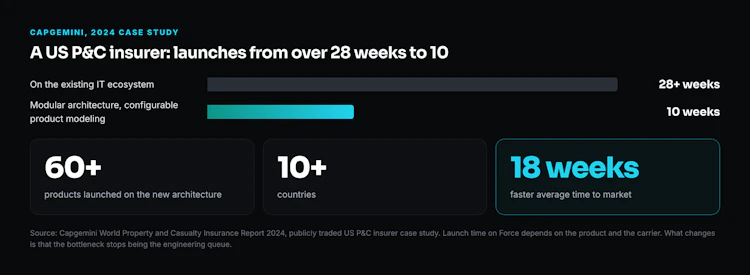
Capgemini's 2024 report describes a publicly traded US P&C insurer whose product launches could take more than 28 weeks on its existing IT ecosystem. After moving to a modular architecture with configurable product modeling, underwriting and policy administration, average time to market fell to 10 weeks, across more than 60 products in more than 10 countries.
That's the effect of separating product logic from platform code. On our side, two things shorten the path further. The platform's API toggle system and flexible workflows are designed to make it easy to launch new lines and adjust processes as the business changes.
And our OnForce agent reads your existing policy documents, extracts the rating variables, eligibility rules and regulatory requirements, and generates validated, ready-to-deploy configurations. Weeks of onboarding work, done in days.
How fast a given product launches depends on the product and the carrier. What changes on Force is that the bottleneck stops being the engineering queue.
How does a no-code PAS fit with the system you already run?
You don't have to replace your core to get this.
Our agents run in your own dedicated environment from day one, alongside the systems you have. PolicyForce and WorkForce are the first two we deploy, on top of your existing carrier systems. The product configuration problem gets solved before any decision about the core is made.
If the agents prove out, the platform is where those steps lead. The first workflow goes through the same validation as everything else we do.
It runs beside your legacy system until you sign off. We explain that in what a parallel run is and how it de-risks a core system replacement.
The strategic version of that argument, why the step size matters more than the vendor, is in how to modernize an insurance core system without a three-year migration.
What should you ask a PAS vendor about configuration?
Three questions from our own vendor checklist, with the answer you'll typically hear and what it usually means.
- How do you handle customization? Do you require proprietary code and specialized engineers?: "Don't worry, things are in progress or will be shipped soon.", A vendor's version of soon and your version of soon are often vastly different. AI-ready stacks need standardized API documentation and universally understood languages that are ready now.
- Will our customizations affect the core platform code?: "We are more configurable than other vendors.", Ask whether that covers launching new products or building document templates in real time. If not, you will be designing your operations around the vendor's system.
- Do your system upgrades require manual control over timing and extensive retesting?: "Lots of things can be done right away.", That usually excludes custom reporting, analytics, and AI agents doing real work. Upgrades that are non-disruptive reflect an integrated design.
Key takeaways
- A policy administration system holds a carrier's product definitions, rating rules, forms, and the full lifecycle of every policy. Everything else in the carrier depends on it.
- Product changes queue behind engineering because in a traditional PAS the product is the code, and 51% of insurance executives in Capgemini's 2024 survey named legacy systems as a top constraint.
- Configuration changes settings the business owns and creates no technical debt. Code modification changes the software and does.
- No-code policy configuration lets business users own rating rules, endorsements and the product lifecycle, with the carrier keeping responsibility for the rating logic and every change logged and auditable.
- Agents can deliver no-code configuration on top of the systems a carrier already runs, before any decision about replacing the core.
Frequently asked questions
What does a policy administration system do?
Related: Insurance Document Automation: From Reading Your Manuals to Mailing the Policy
It manages the full lifecycle of an insurance policy: quoting, binding, issuing, endorsing, renewing and canceling. It holds the product definitions, rating rules, and forms that determine what a carrier sells and at what price. Billing, claims, and reporting all draw on it.
What is no-code policy configuration?
It's the ability for business users, such as product managers and underwriting leads, to build and change insurance products through configuration rather than code. Rating rules, endorsements, and lifecycle stages become settings the business owns, so a product change no longer requires a developer or a release.
Does no-code configuration mean the AI sets our rates?
No. In our platform the rating algorithms remain the carrier's responsibility. AI helps translate your existing rules and documents into working configuration and provides context, but the decisions about rates and eligibility are made by your team. Every change is logged and subject to your approval thresholds.
Can we get no-code configuration without replacing our core system?
Yes. Our PolicyForce and WorkForce agents deploy first, in your own dedicated environment, on top of the carrier systems you already run. The full platform is where that can lead on your timeline, not a prerequisite for starting.
Final thoughts
The policy administration system is where a carrier's products live, and for many carriers it's also where product changes wait.
No-code configuration ends the wait by giving the product back to the people who own it. Rating rules, endorsements and lifecycle become settings, not releases.
The control doesn't go away. The carrier keeps responsibility for the logic, every change is visible, and approval is yours to set.
The engineering queue was never the price of doing business. It was the price of the architecture.
Related: Premium Leakage: How Disconnected Systems Quietly Cost Carriers Money
See what Force does with your operations
Bring us a product change that has been waiting on engineering and we'll show you what it looks like as configuration.
Book a demo of Force and we'll start with your product, not our roadmap.