You Do Not Have to Replace Your Core System to Use AI
Carriers need AI now. They can't wait for a full rebuild. And yet the first thing most vendors put on the table is a rebuild.
Does it have to be that way? No. You can use one expertly engineered, customizable, modern, and fast-to-ship microservice to fix one workflow problem, inside your own environment, on top of the core you run today.
Nothing gets ripped out. If it works, you do the next one. Here's how that works, what it needs from you, and where it leads.
Start with one workflow, not a platform
You start with a modern microservice, not a platform.
A modern configurable microservice takes one workflow you already run, such as creating a new product, verifying a claim or answering a policyholder, and executes it under your rules. It runs in your own dedicated environment, with your own database, and your own security boundary.
It connects to the systems you have. It doesn't replace them.
The sequence is short:
- Pick the workflow that costs you the most. Not the easiest one to move. The one people complain about.
- Deploy one modern, fast-to-ship microservice to address it, in your environment, alongside your existing core.
- Keep everything else running exactly as it does now.
- Then decide the next step, on your timeline.
That's the whole plan.
Give us a problem. We fix it with modern, customizable microservices. Grow into our platform, if and when you want to.
Why carriers expect a rebuild to be the only option
Because for years, that was the only thing on offer.
The traditional way to improve a carrier’s tech stack was to replace the core system. That's an 18 to 36 month program (at least), a large upfront license, third-party consultants, and one go-live day nobody wants to own.
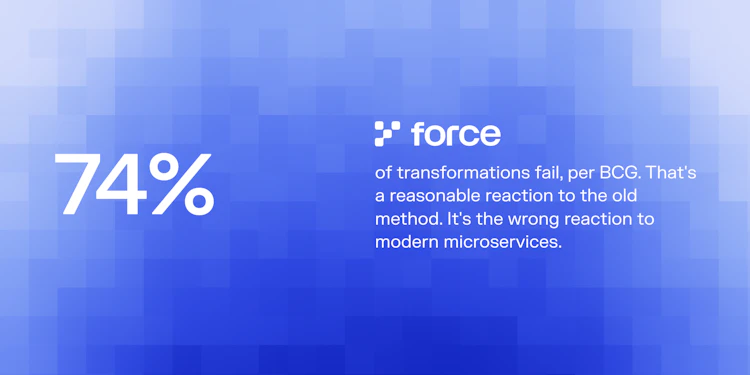
BCG puts the share of transformations that fail at 74%. In West Monroe's 2025 survey, 54% of insurers said more than half their IT budget goes on maintaining existing systems. 52% had delayed or canceled two to three major technology projects in the past year for budget reasons.
So when a vendor says "AI," a CIO hears "ugh, another one of those." That's a reasonable reaction to the old method. It's the wrong reaction to modern microservices.
What's on offer today, and why it falls short
Three things, and each has the same gap.
- Generic AI wrappers with no insurance logic. A general model with a chat window. It doesn't know what an endorsement is, what your appetite is, or which state you're in.
- One-time data pulls with no governance trail. A pilot that extracts data, produces a result, and leaves no record of how. Fine for a demo. Useless for an examiner.
- No path from the AI pilot to a connected platform. The pilot works, then sits there, because there's no route from it to anything bigger.
What carriers actually need is different: microservices and agents built for real carrier operations, data that’s unified in one place and actions that are fully governed, and a clear path from microservices and agents to a full platform. We wrote about the thinking behind that in why we built Force.
What starting with one workflow looks like
It looks like a decision about pain, not about architecture.
Ask your teams which process they'd most like to stop doing by hand. The answers are usually specific. Every rate change waits on engineering. Every claim needs someone to read thirty photographs. Every policyholder call is a lookup the website should have answered.
Each of those is one workflow, and each has a microservice or an agentic solution:
- Rate changes wait on engineering: Product configuration, PolicyForce
- A policy needs six people to touch it: Lifecycle orchestration, quote to renewal, WorkForce
- Onboarding a product takes weeks of reading: Document interpretation, OnForce
- Call volume is lookups: Policyholder and staff self-service, AssistForce
- Inspections and adjustment cost too much: Claims verification, InspectForce
- Leadership sees last month's numbers: Analytics and decision support, PulseForce
- Print and mail is still a department: Document generation and mailing, PrintForce
You don't need all seven. You need the one that matches the answer your team gave. We go through each in AI agents in insurance: what they actually do.
Where the agent actually runs
In your own dedicated, isolated environment. Not in a shared instance with other carriers.
That means your own database, your own agents, your own intelligence layer. Data isolated in your security boundary, configured for your business rules.
And we never train on your data. The agent learns your operations and sharpens with every interaction, but that intelligence accumulates in your own configurations and retrieval. It doesn't leave your boundary to improve a model another carrier then benefits from.
This is the part that makes "without replacing the core" honest.
Our microservices and agents run in the same environment the full platform would run in. That's why we call it the on-ramp to your new core, not a detour from one.
Every carrier gets isolated infrastructure. Your data stays yours.
What the carrier provides, and what Force builds
Knowledge, rules, and decisions. We do the building.
For a first agent, your side of the work is:
- The workflow knowledge. Manuals, procedures, rules, and access to the people who know the exceptions.
- The governance decisions. Which tasks need a human to approve, what the thresholds are, who can escalate.
- The sign-off. Configurations are reviewed and approved by your team before anything runs live.
Our side: the environment, the agent, the configuration, the integration to your existing systems, and direct access to the engineers doing the work. Direct access means direct. No intermediary layer, no consulting firm in between.
How you know it's working, and how you keep control
Every agent action is logged with complete traceability. Who decided what, when, and why.
That's not a feature you switch on. It's how the agents are built. Agent decisions are documented and inspectable, so compliance and regulators can review what each agent does and on what data.
Your team defines approval limits, escalation triggers, and routing.
Those rules are enforced at the agent layer. AI-assisted actions operate within boundaries you set.
The practical result is that the first agent is a controlled experiment with a full record. You can widen what it's allowed to do as the audit trail earns trust, or narrow it, or stop. None of those decisions require a new system of record.
What happens after the first agent
Whatever you decide. That's the point.
You can add a second agent on the next workflow. You can add the suite. Or, having seen the agents work on your own operation, you can decide the connected platform is where you want to end up, and move to it one module at a time.
The route is the same in every case. Agents run in your environment from day one. Each new one connects to what's already running.
If you go all the way to the platform, you get there without a single all-or-nothing day, because every step was validated beside the system you had. We describe that path, and why the size of each step matters more than the vendor, in how to modernize an insurance core system without a three-year migration.
And the thing carriers most often start with, the workflow where a policy needs too many hands, has its own guide: policy lifecycle automation from quote to renewal.
Five questions to ask before you start
Five questions. A genuine agent answers all of them.
- Does it execute a workflow, or answer questions about one? An agent moves the work.
- Does it run in our environment, on our data? If your data leaves your boundary to be processed, it's a service, not an agent.
- Does it apply our rules, or generic ones? Coverage explanations aligned to your underwriting rules are an agent. A general model guessing is a liability.
- Can we see why it did what it did? Every decision logged. If not, it's a black box with a friendly name.
- Is there a path from this to the next one? A pilot with no route to a platform is the one-time data pull you've already tried.
Gartner predicted in June 2025 that over 40% of agentic AI projects will be canceled by the end of 2027. Part of the reason it gave was "agent washing," the rebranding of assistants, RPA and chatbots as agents. The aforementioned five questions are how you avoid buying one of those.
The wider picture of how AI fits across a carrier, from rules-based automation to agents to platform, is in AI for insurance carriers: the complete guide.

Key takeaways
- You can use AI in a carrier without replacing the core system. Deploy one agent on one workflow, in your own environment, on top of what you run today.
- The rebuild reflex is a reaction to the old methodology, where capability meant an 18 to 36+ month program. BCG puts the failure rate of transformations at 74%.
- Generic AI wrappers, one-time data pulls, and pilots with no path forward all share the same gap: no insurance logic, no governance trail, no route to a platform.
- Agents run in a dedicated environment with your own database and boundary. Every action is logged, thresholds are yours to set, and Force never trains on your data.
- The first agent is the on-ramp to a new core, not a layer bolted onto the old one. What comes next is your decision, on your timeline.
Frequently asked questions
Can insurance carriers use AI without replacing their core system?
Yes. AI agents can run on one specific workflow, such as product configuration, claims verification or policyholder service, inside the carrier's own dedicated environment and on top of the existing core. Nothing is replaced to start. The full platform is an option for later, not a prerequisite.
What is the first step for a carrier that wants to use AI?
Pick the workflow that costs the most, and put one agent on it. The carrier provides the workflow knowledge and the governance decisions, such as approval thresholds and which tasks need human oversight. Force provides the environment, the agent, the configuration and the integration to existing systems.
Is an AI agent the same as a chatbot?
No. A chatbot answers questions. An agent executes a workflow under the carrier's rules, with every action logged. A coverage explanation aligned to your own underwriting rules, with the reasoning on the record, is agent behavior. A general model guessing at coverage is not.
What happens to our data when we use AI agents?
It stays in your dedicated environment, with your own database, and your own security boundary. Force never trains on carrier data. The intelligence the agent builds up accumulates in your own configurations and retrieval, and role-based access limits the agent to the records its task requires.
Final thoughts
The reason carriers hesitate on AI isn't AI. It's the rebuild that used to come attached to it.
Detach the two and the decision gets small. One agent, one workflow, your environment, your rules, a full record of what it did.
Start with the workflow your team would most like to stop doing by hand.
If it works, do the next one. If it doesn't, you've lost a quarter, not three years.
See it on your own operations
Dedicated AI agents in your own environment, on the systems you already run.
Book a demo of Force and bring the one process everyone complains about.