Why Insurance AI Pilots Stall and How to Get One Into Production Quickly
Insurance AI pilots don't stall because the AI is weak. They stall because they're built beside the work, not inside it. Someone has to check every answer, and the checking costs more than the work it saves.
The fix is smaller than it sounds. Put AI on one workflow, in your own environment, with every decision on the record.
Done that way, your first workflow can be live in 3 to 6 months, not the 18 to 36+ months of a traditional core implementation. So why do pilots get stuck, and what's the fast route out?
Why pilots stall
Because the math doesn't work yet. A pilot that needs a person to check, correct, and explain every output isn't saving anyone time.
Adam Ibrahim, our co-founder and CEO, told Digital Insurance in September, "AI cannot create any real value until it gets to a high enough level of accuracy that the productivity is not outweighed by the cost of monitoring, governing and maintaining the system."
That's the stall in one sentence. Good enough for a demo isn't good enough for production.
Adam's read on the industry is blunt: "Presently, the equation is net negative, which is why we aren't seeing any of the economic benefits flow through the financials of carriers yet." He means the industry as a whole, and AI bolted on from the outside.
"AI cannot create any real value until it gets to a high enough level of accuracy that the productivity is not outweighed by the cost of monitoring, governing and maintaining the system."
Pilot versus production
A pilot proves something can work. Production proves it can do the work, every day, on real files, under your rules.
- A pilot runs on a sample. Someone checks every output. When it's wrong, nobody's quite sure why.
- Production runs on live work, inside the workflow. It applies your rules, logs who decided what, when, and why, and hands a case to a person only where your rules say it should.
Related: AI Agents in Insurance: What They Actually Do (7 Real Examples)
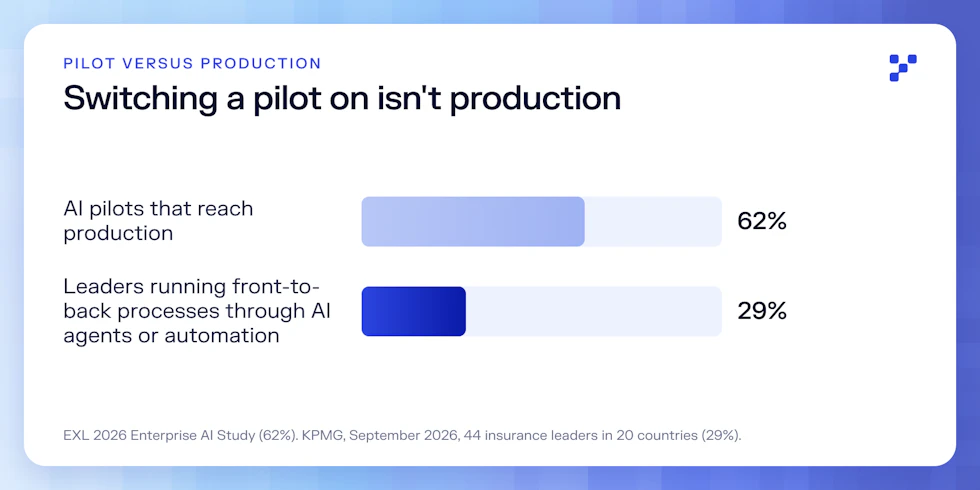
Switching a pilot on isn't the hard part. EXL's 2026 Enterprise AI Study found insurers move more AI pilots into production than any other industry it surveyed, with 62% of pilots reaching production.
Doing the whole job is rarer. In KPMG's September 2026 survey of 44 insurance leaders across 20 countries, just 29% said they're running front-to-back processes through AI agents or automation.
EXL says the pilots that advance share three traits: "a clear business owner, a defined outcome, and agreement on what 'production ready' means." We'd add a test of our own: a pilot is in production when the checking costs less than the work it saves.
A pilot is in production when the checking costs less than the work it saves.
The monitoring bill
Because everything it produces has to be checked, moved, and explained by hand. What's on offer to carriers tends to share three gaps:
- Generic AI wrappers with no insurance logic. They don't know your appetite, forms, or states.
- One-time data pulls with no governance trail. Nobody can show how the answer was reached.
- No path from AI pilot to connected platform. It works in a corner, and stays there.
Each gap adds to the monitoring bill. The output becomes another manual handoff into legacy tech, and someone still has to explain it to compliance and regulators.
Adam came to this from the carrier side, after five years on the board of a regional P&C carrier. He's seen what a pilot looks like from the boardroom.
That's why we start inside the core, not beside it.
The fast route
One workflow, in your own environment, proven against your legacy tech before it goes live.
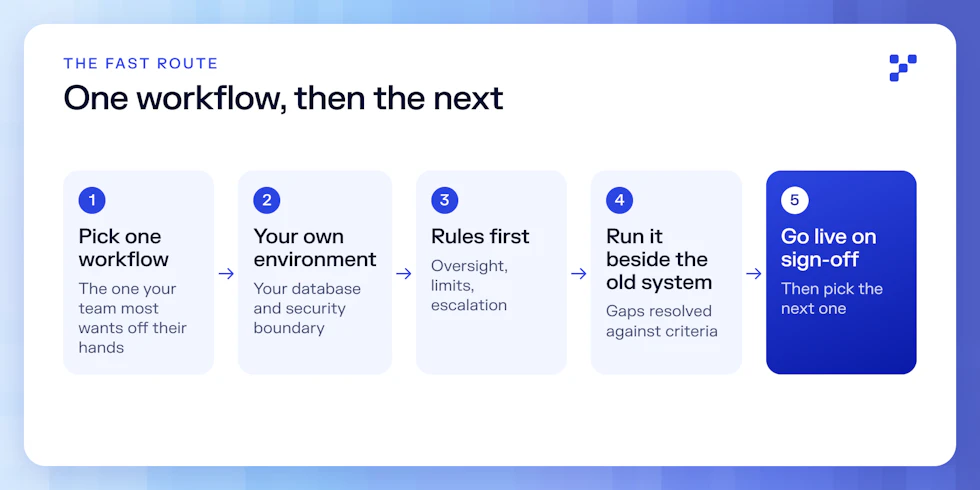
- Pick one workflow. The one your team would most like to stop doing by hand.
- Run it in your own environment. Your own database, agents, and security boundary, configured to your business rules.
- Write the rules down first. Your team defines which tasks require human oversight, plus the approval limits, escalation triggers, and routing.
- Run it beside the old system. Our platform processes the same work in parallel, and discrepancies are resolved against formal acceptance criteria.
- Go live when you sign off. Nothing goes live until you do. Then pick the next workflow.
On the calendar, that's Discover in weeks 1 to 4 and Build in weeks 4 to 12. Validate runs in weeks 10 to 16, then Go Live in weeks 16 to 20, followed by a HyperCare period.
First workflow live in 3 to 6 months. We set out each phase in how Force implements, in five phases.
That covers EXL's three traits by design: an owner, a defined outcome, and acceptance criteria you sign.
Where to start
A simpler one than you'd think. Adam was asked about the biggest opportunity for insurtechs over the next six months. His answer: "Getting useful work in core systems, using AI to a high level of consistency and reliability, even if it is only with simpler tasks."
Simple, repeatable work is the easiest to prove. Good candidates:
- Reading policy manuals. OnForce reads carrier policy documents and extracts rating variables, eligibility rules, and regulatory requirements. We explain how in policy document extraction with AI.
- Configuring products. PolicyForce lets business users build and manage products without engineering, so a new product, line, or state gets to market faster.
- Printing and mailing. PrintForce deploys independently, which makes it a low-risk first step.
No rip and replace
No. You need one modern, customizable, fast-to-ship microservice on the workflow that hurts, running in your own dedicated environment from day one.
It connects to the systems you already run. Keep everything else running exactly as it does now. Give us a problem, we fix it.
Microservices and agents are the on-ramp. They run in the same environment our full platform runs in, so the first one is the on-ramp to your new core, not a layer bolted onto the old one.
Moving to a modern core like ours is still the step carriers eventually need. You'll take it on your timeline, with proof in hand. More in you don't have to replace your core system to use AI.
Measure the outcome
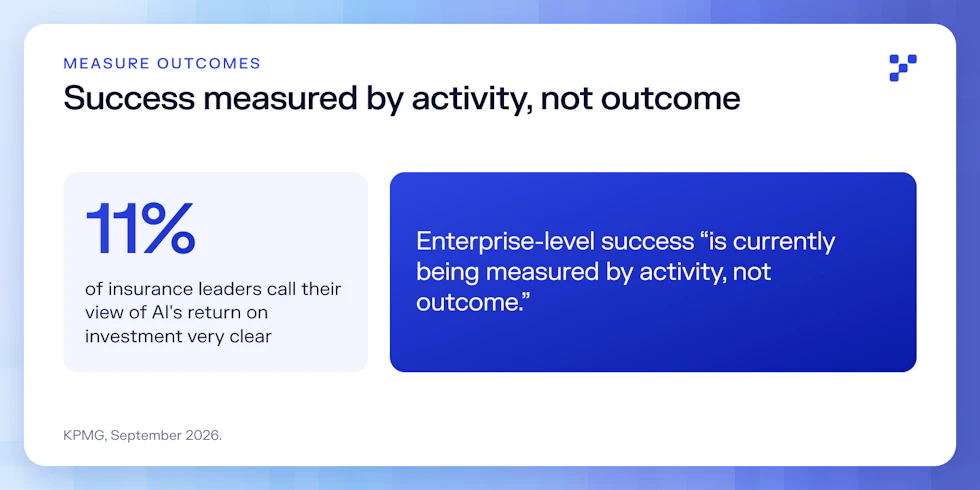
By outcome, not activity. KPMG's report says enterprise-level success "is currently being measured by activity, not outcome." Only 11% of its respondents described their view of AI's return on investment as very clear.
Four questions tell you more:
- Did it meet your acceptance criteria? In a parallel run, the same work goes through both systems and the outputs are compared.
- How much checking does it still need? If a person reviews everything, it's still a pilot.
- Can you see why it did what it did? Every decision logged, with visible logic. No black boxes.
- Will the business owner sign off? If they won't put their name on go-live, it isn't ready.
When all four answers are yes, the equation has flipped.
Governance is the shortcut
Because governance shrinks the monitoring bill. If every decision is already on the record, nobody rebuilds the story afterward.
On our platform, every agent action is logged with complete traceability: who decided what, when, and why. Compliance and regulators can review what each agent does and on what data.
Your team defines approval limits, escalation triggers, and routing, enforced at the agent layer. Agents do the work, and only the exceptions and edge cases go to a person. That's the whole point of agentic AI. We cover where that line goes in human in the loop in insurance AI.
Already live
Routine work runs in the background. People focus on what matters.
$85M+ in written premium runs on Force, with 60K+ active users across policyholders, agents, and carrier teams. That's production, not a pilot.
We never train on your data. The intelligence accumulates in your own configurations and retrieval, shared across our seven AI agents. Subsequent modules deploy faster, because the foundation is already in place.
Key takeaways
- Insurance AI pilots stall when the cost of monitoring, governing, and maintaining the AI outweighs the productivity it adds.
- Switching a pilot on isn't production. In KPMG's September 2026 survey, just 29% of insurance leaders said they run front-to-back processes through AI agents or automation.
- The fast route is one workflow, in your own environment, with your rules and a full record, proven beside legacy tech before go-live.
- With Force, the first workflow is live in 3 to 6 months, against 18 to 36+ months for a traditional core implementation.
Frequently asked questions
Why do insurance AI pilots stall?
They stall when checking, correcting, and explaining the AI's output costs more than the work it saves. That happens when a pilot sits beside the core systems instead of inside them, with no record of how it reached an answer.
What is the difference between an AI pilot and production?
A pilot runs on a sample, with a person checking every output. Production runs on live work under the carrier's own rules, with every decision logged and a person stepping in only where the rules say so.
Do carriers have to replace their core system to move a pilot into production?
No. One modern microservice or agent can run on one workflow, in the carrier's own dedicated environment, alongside the existing core. A modern core is still where carriers eventually need to go, on their own timeline.
How should a carrier measure whether a pilot worked?
Against acceptance criteria agreed before the build, in a parallel run on the carrier's own work. Then check how much human review it still needs, and whether the business owner will sign off on go-live.
Final thoughts
Pilots don't stall for lack of ambition. They stall when the checking costs more than the work.
So shrink the problem. One simpler workflow, in your own environment, with the rules written down and every decision on the record.
Prove it beside your legacy tech, sign it off, and go live. Then do the next one.
One workflow live in 3 to 6 months beats a pilot that's still being checked by hand.
See it on your own operations
Bring us the pilot that's stuck. We'll show you what production looks like on your own work.