
Insurance Inspection Automation: What AI Can and Cannot Verify
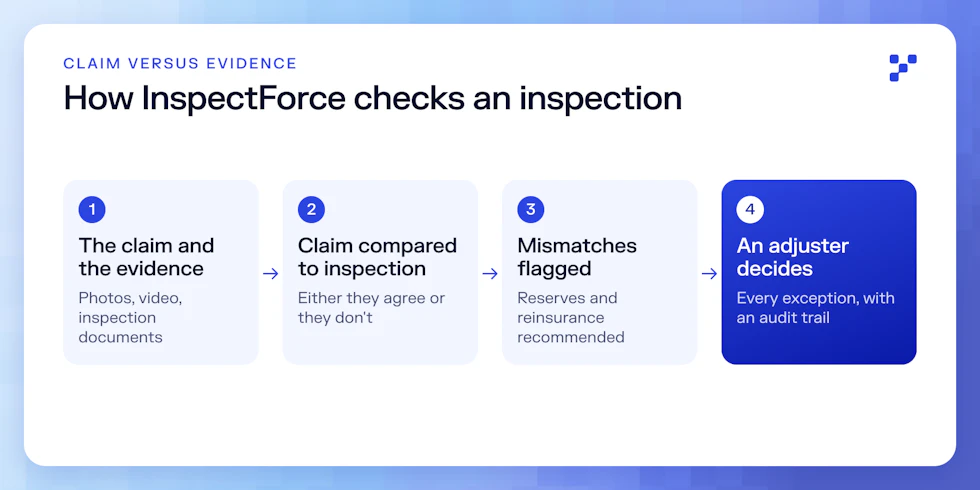
Insurance inspection automation uses AI to read the photos, video, and inspection documents on a file and check them against the claim. It can verify whether the evidence and the claim agree, and show exactly where they don't.
It can't verify what nobody captured, and the exceptions still go to a person. That isn't a weakness.
In our view, it's why inspections are such a good place to start with AI. The scope is narrow, the evidence is already on the file, and you can prove the result. Here's what AI checks, what stays with your people, and where to begin.
What AI can and can't check
It can verify agreement between records. It can't verify what's outside them.
You'll see this sold as claims inspection software or virtual inspection. On our platform, it's InspectForce, Force AI's agent for inspection and claims verification. Here's what it checks:
- What the evidence shows. It analyzes images, video, and inspection documents.
- Whether the claim matches the inspection. It detects fraud through claim-to-inspection comparison, and every mismatch comes with its reason.
- What the verified scope means for the reserve. It produces automated reserve and reinsurance recommendations.
Here's what evidence alone can't settle:
- Anything that isn't in the file. A photo only shows what's in the frame.
- Why a mismatch exists. Fraud, an honest mistake, or a missing photo can look alike on paper, so a person decides which it is.
- The edge cases. Files inside your limits move on. A mismatch, a fraud flag, or a reserve above your limit goes to an adjuster, and the record shows what they decided.
It can verify agreement between records.
Narrow and provable
Because you can prove whether it works.
Adam Ibrahim, our co-founder and CEO, told Digital Insurance in September what he'd tell other insurtech leaders: "Focus on building something that is actually useful in a provable way, even if the scope is narrow."
An inspection is about as narrow and provable as insurance work gets. There's a claim, and there's evidence. Either they agree or they don't, and a person can check every answer.
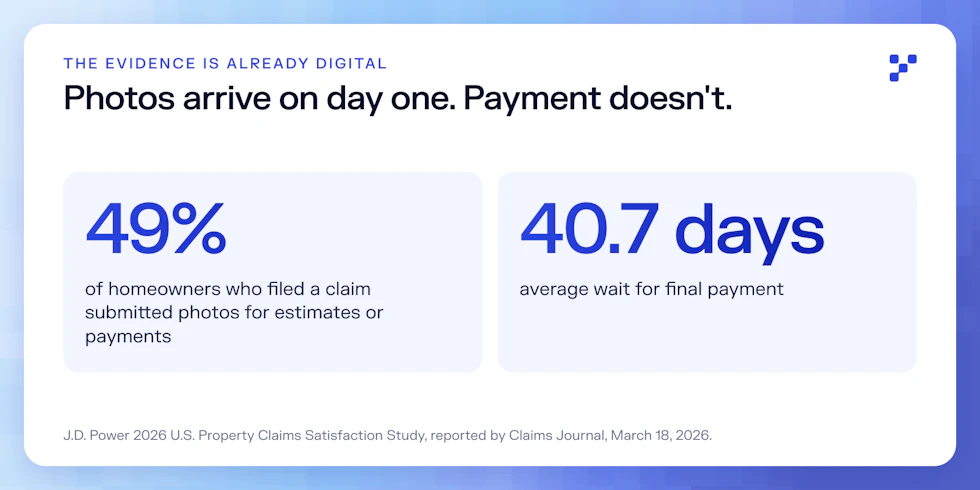
The evidence is already arriving digitally, too. J.D. Power's 2026 U.S. Property Claims Satisfaction Study surveyed 5,093 homeowners who'd filed a claim. Claims Journal reported on March 18, 2026 that 49% of them submitted photos for estimates or payments.
The same study put the average wait for final payment at 40.7 days. Photos that arrive on day one can be read on day one.
InspectForce is one of seven Force agents, each built for one workflow, which we describe in AI agents for insurance companies.
"Focus on building something that is actually useful in a provable way, even if the scope is narrow."
Claim against evidence
By putting two records side by side: what was claimed, and what the inspection evidence shows.
The claim says what happened and what was damaged. The photos, video, and inspection documents show what's actually there. Visual AI reads both and marks where they line up and where they don't.
Every mismatch carries its reason. That's the difference between a flag an adjuster can act on and a score nobody can explain.
It also changes how the evidence gets collected. The policyholder uploads photos, rather than an inspector driving from site to site to take them.
Once the scope is verified, the same agent recommends a reserve and, where a treaty applies, a reinsurance position. We walk through fraud detection and reserving step by step in AI claims processing.
What a person checks
The things a regulator or a lawyer will ask about. On every file, someone should be able to answer four questions:
- What cleared the reserve? The limit it passed, or the adjuster it was routed to.
- Where is the comparison logged? The claim, the inspection, and what didn't match.
- Why was it flagged? The evidence the AI pointed to, in plain view.
- How is it checked for bias? Before it reaches a policyholder, not after.
An inspection workflow should answer all four on every file. On our platform, every recommendation carries an audit trail with detailed node results, plus a visual step and approval flow. That's how compliance and regulators can review what the agent did, and on what data.
The timing of human review is tracked. Schema masking keeps personal bias data away from the model, and output auditing is configurable. Role-based access covers people and AI agents alike.
We cover where a person should decide in human in the loop in insurance AI.
If you can't show why a claim was flagged, you can't defend the flag.
Where the savings show
It takes out site trips and hours of reading.
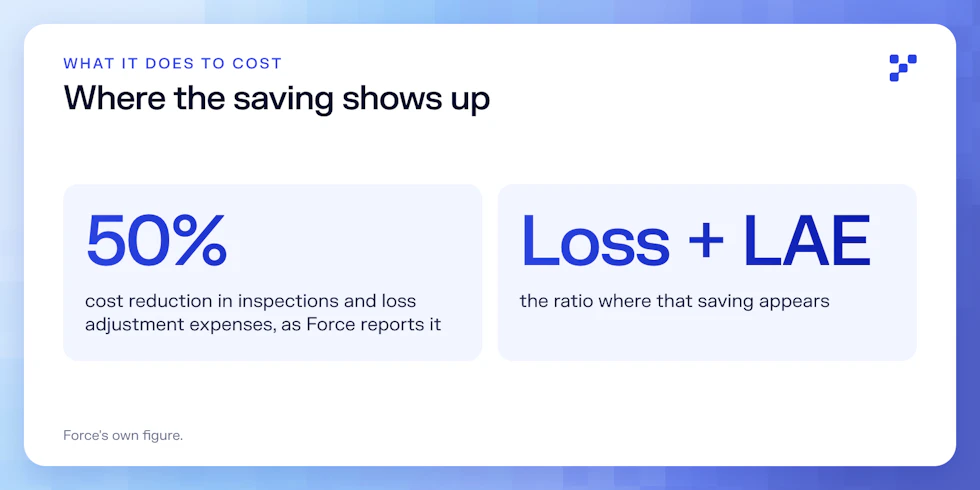
Our own figure is a 50% cost reduction in inspections and loss adjustment expenses. Inspections get completed from evidence already on the file, and adjusting starts from a verified scope instead of a folder of attachments.
It's worth knowing where that saving lands. A claims inspection is a loss adjustment expense. So the saving shows up in your loss and LAE ratio and your combined ratio, not your expense ratio.
That distinction matters when you build the business case. We break down where each kind of saving lands in how to reduce an insurance expense ratio.
What changes for people
They spend their time on judgment instead of collection.
Force is designed to elevate teams, not replace them. Claims teams move faster with AI-assisted workflows.
Routine work runs in the background. People focus on what matters.
In practice, that means fewer trips to take pictures. The agent does the comparison, and the adjuster takes the cases that need judgment.
It also means the file a person opens is already structured. The flags have reasons, the recommendation has its logic attached, and the decision is theirs to make and record.
Where to start
One inspection type, proven before it's expanded.
- Pick one inspection type with steady volume. Narrow beats broad: It's easier to prove.
- Agree on what "verified" means. Your adjusters know which mismatches matter. Write that down first.
- Set the line where a person must look. Approval limits, escalation triggers, and routing are yours to configure.
- Prove it on files you can check. Compare the agent's flags and reserve recommendations with what your adjusters decided.
- Measure cost and time separately. Inspection cost and days to final payment move for different reasons.
InspectForce runs in your own dedicated environment, next to the claims systems you already run. Microservices and agents are the on-ramp. Give us a problem, we fix it, and you grow into our full platform if and when you want to.
Key takeaways
- Insurance inspection automation verifies whether the claim and the evidence agree. It can't verify what was never captured, and the exceptions go to a person.
- InspectForce analyzes photos, video, and inspection documents, detects fraud through claim-to-inspection comparison, and recommends reserves and reinsurance.
- Inspections are a strong first use of AI: the scope is narrow, the evidence is on the file, and a person can check every result.
- Every recommendation carries an audit trail, the timing of human review is tracked, and files outside your limits go to an adjuster.
- Force reports a 50% cost reduction in inspections and loss adjustment expenses, a saving that shows up in the loss and LAE ratio.
Frequently asked questions
How is AI used in insurance inspections?
AI reads the photos, video, and inspection documents on a file and compares them with the claim. It flags mismatches with the reason attached and recommends a reserve and reinsurance position. Files inside your limits move on, and mismatches, fraud flags, and reserves above your limits go to a person.
Can AI replace a human inspector?
No, and it isn't built to. The agent does the reading and the comparison, so fewer trips are needed to take pictures. Adjusters and inspectors keep the judgment calls, the conversations, and the exceptions.
How does an inspection connect to the claim and the reserve?
The inspection evidence is compared with the claim to verify the scope. Once the scope is verified, InspectForce recommends a reserve and, where a treaty applies, a reinsurance position. Inside your limits, it moves on. Above them, the adjuster approves, adjusts, or overrides it, and that's on the record.
What should a carrier automate first?
Start with one inspection type that has steady volume. Agree with your adjusters on what counts as verified, and set the thresholds that send a file to a person. Then prove the results on files you can check before you expand.
Final thoughts
AI is good at one thing in an inspection: checking whether the evidence and the claim agree, every time, on every file.
It isn't the judge. It doesn't know what wasn't photographed, and it shouldn't decide what a mismatch means.
That's exactly why inspections are a smart place to start. Narrow scope, real evidence, and results a person can prove.
Start there, send the exceptions to your people, and keep every decision on the record.
See it on your own operations
InspectForce reads the evidence, compares it with the claim, and recommends the reserve. Your adjusters get the exceptions.
Book a demo of Force and bring an inspection type your team handles every week.