
How to Reduce an Insurance Expense Ratio: Where the Savings Are
The obvious way to reduce an insurance expense ratio is to cut cost. We'd start with the other half of the math.
The expense ratio is underwriting expenses divided by premium. So writing more premium on the same cost base lowers it, just like cutting does. Launch a new product, line, or state faster, without ripping out the system underneath, and the ratio can fall while revenue grows.
Then go after the cost of the gaps between your systems: rekeying, handoffs, print and mail, call volume, and inspections. Here's where each saving sits.
The short answer
Pull two levers, in this order.
- Grow premium faster than expense. Every launch that reaches market sooner, on the same team and systems, spreads the cost you already carry over more premium.
- Take out the work that only exists because systems don't connect. Typing the same fact twice. Chasing a handoff. Reconciling one system against another.
The savings sit in five places: product launches and changes, rekeying and handoffs, print and mail, call volume, and inspections.
The first four sit mostly in the expense ratio. Inspections are different. A claims inspection is a loss adjustment expense, which the NAIC counts on the loss side.
The benchmark
It's the share of premium a carrier spends to get, write, and run its business. Claims aren't in it.
The NAIC's 2025 full-year results put the US property and casualty industry's expense ratio at 25.8%, against 25.3% in 2024. Behind that figure are $252.2 billion of underwriting expenses and $976.8 billion of net premiums written. The industry's combined ratio was 92.9%.
Two things to know before you compare yourself to that number:
- Loss adjustment expense isn't in it. The NAIC counts it inside the net loss ratio.
- It's an average of everything. It blends every line and every way of distributing a policy.
Your own ratio, line by line, against last year is the benchmark that matters.
Your own ratio, line by line, against last year is the benchmark that matters.

Where the points go
Four kinds of underwriting expense:
- Commissions and brokerage: what you pay to distribute the policy.
- Taxes, licenses, and fees: largely set by the states.
- Other acquisition costs: the cost of getting and writing new business beyond commissions.
- General expenses: the cost of running the operation day to day.
You'll also hear it called the operating expense ratio. Commissions pay for distribution, and taxes, licenses, and fees are largely set by the states. Software won't do much for either one.
The other two lines are different. That's where daily work turns into expense, and where the gaps between systems show up as cost.
Loss adjustment sits outside all four. It's counted with losses, not with underwriting expenses.
Grow the denominator
Because the ratio is a fraction, and cost is only half of it.
Related: Insurance Document Automation: From Reading Your Manuals to Mailing the Policy
The NAIC's own explanation for 2025 makes the point. The ratio stayed nearly flat because a 6.4% rise in other underwriting expenses outpaced the growth in net premiums written. Premium grew, and cost grew faster.
So the question isn't only "what can we cut?" but also "how fast can we launch?" Our own materials put the problem plainly: legacy systems slow product launches and market response.
That's why we lead with revenue. Our platform helps a carrier take a new product, line, or state to market faster, without ripping out the system underneath. OnForce reads your rating manuals into validated configuration, and PolicyForce lets business users build and manage products without engineering.
New premium still pays commissions and premium taxes. What it shouldn't need is a project team and an engineering queue for every launch. We explain the reading step in policy document extraction with AI.

The cost of the gaps
Because every gap between systems is work someone gets paid to do.
Adam Ibrahim, our co-founder and CEO, told Digital Insurance in September what our platform is built to fix. It's aimed squarely at the gaps: "Force also tackles disconnected systems by unifying underwriting, claims, billing, reporting, origination and policyholder experiences into one system."
When those run in separate tools, the result is manual handoffs and duplicated work. Someone retypes a submission. Someone chases a handoff between underwriting and policy admin, and someone else reconciles billing against the policy record.
None of that has its own budget line. It's spread across salaries and overhead, where it's hard to see. In our view, much of the expense a carrier controls is the cost of the gaps between systems.
The same gaps leak revenue too, which we cover in premium leakage.
"Force also tackles disconnected systems by unifying underwriting, claims, billing, reporting, origination and policyholder experiences into one system."
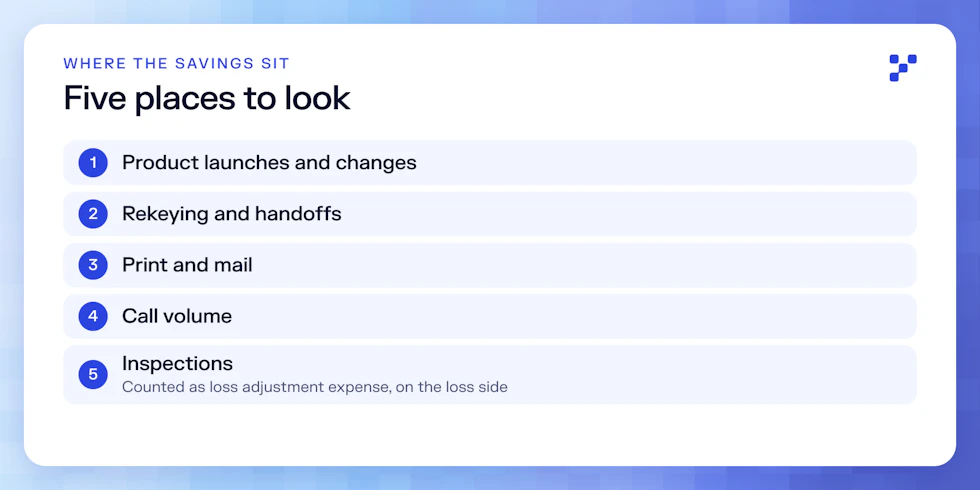
Five places to look
Start with these five. Each one maps to one of our agents.
- Product launches and changes. A rate change or a new endorsement shouldn't wait on a release. PolicyForce turns products into configuration that business users own.
- Rekeying and handoffs. WorkForce runs the policy lifecycle from quote to renewal as a no-code workflow with rules and triggers. It also gives real-time visibility into execution paths and bottlenecks.
- Print and mail. PrintForce replaces the printing and mailing operation inside your governed environment. It's built on proven service providers, which eliminates traditional implementation overhead.
- Call volume. AssistForce gives policyholders and staff natural-language access to policy, claims, and billing information. Its self-service capability dramatically reduces call center volume.
- Inspections. InspectForce analyzes photos, video, and inspection documents, and compares the claim with the inspection. Our own figure is a 50% cost reduction in inspections and loss adjustment expenses.
Across origination, policy admin, and policyholder experiences, we report 5 to 10X productivity gains on our platform. We explain what inspection AI can and can't check in insurance inspection automation.
From hours to points
Only when the saving reaches the books, or when the same team writes more premium.
A process that runs faster but leaves the same cost in place doesn't move the ratio. That's the honest test for any automation project, ours included.
There are two ways a saving lands:
- Capacity. The same team handles more premium. Force is designed to elevate teams, not replace them, so routine work runs in the background and people focus on what matters. Growth without matching headcount lowers the ratio.
- Spend that stops. A print and mail operation you no longer run is cost that leaves the ratio.
Inspection savings follow a different path. Claims inspection costs are loss adjustment expense. The saving shows up in your loss and LAE ratio and your combined ratio, not the expense ratio.
No rip and replace
No. Start with one modern, customizable, fast-to-ship microservice on the workflow that costs you the most.
Microservices and agents are the on-ramp. They run in your own dedicated environment from day one, next to the legacy tech you already run. They're the on-ramp to your new core, not a layer bolted onto the old one.
Give us a problem, we fix it.
There's a tension worth being honest about. If the gaps between systems are the cost, then moving to a modern core like ours is still the step carriers eventually need to make.
The difference is timing. Under the old methodology, a core implementation takes 18 to 36+ months. Our timeline is 3 to 6 months to the first workflow live.
We make that case in full in using AI without replacing your core system.
Key takeaways
- The expense ratio is underwriting expenses divided by premium, so growing premium faster than cost lowers it just as cutting does.
- The NAIC put the US property and casualty industry's expense ratio at 25.8% for 2025, with loss adjustment expense counted on the loss side.
- Commissions, taxes, licenses, and fees are largely fixed by distribution and the states. Other acquisition and general expenses are where daily work turns into cost.
- Disconnected systems create the work that inflates the ratio: rekeying, handoffs, reconciliation, print and mail, and calls.
- Automation only lowers the ratio when the cost actually leaves the books, or the same team writes more premium.
Frequently asked questions
What is a good expense ratio for an insurance company?
There's no single good number, because commissions and line mix differ from carrier to carrier. As a reference point, the NAIC reported a US property and casualty industry expense ratio of 25.8% for 2025. The more useful benchmark is your own ratio by line, year over year.
What is the fastest way to lower an insurance expense ratio?
Write more premium on the same cost base. Launching a new product, line, or state sooner, without a new project team or a core replacement, lowers the ratio while revenue grows. Cutting the manual work between systems comes next.
How does automation affect the expense ratio?
It lowers the ratio when it removes cost you're actually paying, like a print and mail operation. It also lowers it when the same team can handle more premium. Claims inspection savings show up in loss adjustment expense, which sits in the loss and LAE ratio instead.
How long before the savings show?
It depends on where you start. Our timeline is 3 to 6 months to the first workflow live. The saving shows once that workflow's cost leaves the books, or your team takes on more premium.
Final thoughts
An expense ratio looks like a cost problem. It's also a speed problem.
Premium that launches sooner spreads the cost you already carry. Work that stops falling into the gaps between systems stops costing you money.
Start with the launch you've been waiting on, and the workflow that eats the most hours.
Then measure the ratio, not the hours.
Then measure the ratio, not the hours.
See it on your own operations
Our platform takes the work out of the gaps between your systems and gets your next product to market sooner.
Book a demo of Force and bring the launch you've been waiting on.