
What Is an AI-Native Insurance Platform? (And What It Is Not)
A core AI-native insurance platform is one where the intelligence and the operations were built together, from the start, as one system. The AI isn't added later. It works inside underwriting, claims, billing, and policy admin., on the same data, under the carrier's own rules.
Why does that matter? Because it's how a carrier can take a new product, line, state, or program to market faster, without ripping out the system underneath.
Our view: the label is now so common that it tells you very little on its own. So here's what it means, what it doesn't, and five questions that help you tell the two apart.
The short definition
It means the intelligence layer and the operational layer were built together, from inception, as one system. That's the test we put in our own guide for carriers evaluating tech vendors. It's also the simplest one to apply.
In practice, three things are true of an AI-native platform:
- One connected system. Underwriting, claims, billing, reporting, origination, and policyholder experiences run on one platform and one set of data.
- AI that does the work. Rules-based automation, machine learning, and generative and agentic AI run in the same system, not as separate add-ons.
- Governance in the architecture. Every AI-assisted decision traces back to the data and the logic behind it.
The payoff is commercial before it's technical. When a product's rules, rating, and workflow live in one configurable place, a new line doesn't wait on a rebuild. Routine work runs in the background, and people focus on what matters.
Where Force came from
Because a carrier asked for help with its core, and patching it wasn't the answer.
Adam Ibrahim, our co-founder and CEO, told Digital Insurance in September that he sat on the board of a regional P&C carrier for five years. Eventually, the carrier asked him and his partner, a full-stack engineer, whether they could help modernize its core system.
Then they reviewed it. Adam put the conclusion plainly: "Our review determined that, in short, we could best help by building a modern, AI-native platform from scratch."
That's where the term comes from for us. It wasn't a branding exercise.
In other words, the answer wasn't a better add-on for legacy tech. It was a core with the intelligence built in. We tell the longer version in why we built Force.
"Our review determined that, in short, we could best help by building a modern, AI-native platform from scratch."
Built in versus bolted on
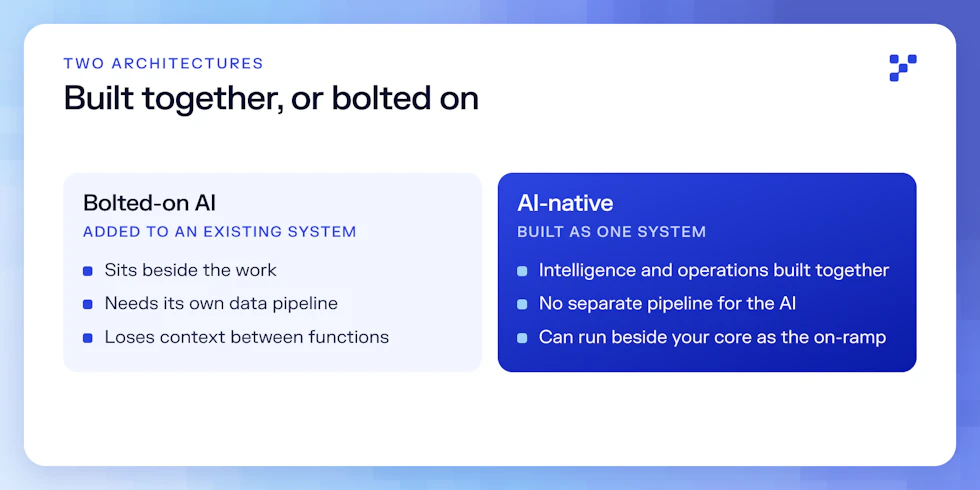
Bolted-on AI sits beside the system that does the work. In an AI-native platform, the AI is part of that system.
The difference shows up the moment a workflow crosses a functional boundary. A bolted-on tool for underwriting doesn't know what claims just learned. Our vendor guide puts it this way: "If AI is a bolted-on feature, it often will suffer from 'amnesia' as the workflow crosses functional boundaries."
Adam is blunter about wrappers and bolt-on AI insight tools. He told Digital Insurance that wrappers aren't very valuable long term. The reason, in his words: they "do not do useful work inside of core systems and are quickly disintermediated by the frontier models, which do the work better without a middleman."
Here's how the two compare in practice:
- Data. Bolted-on AI needs its own pipeline, APIs, and integrations. AI-native platforms read operational data where it already lives, with no extraction step.
- Context. Bolted-on AI starts over at each handoff. AI-native platforms carry context from submission through claims and billing.
- Scope. Bolted-on AI often stops at the front end, like document intake. AI-native platforms work across the whole policy lifecycle.
- Governance. Bolted-on AI adds an audit trail afterward, if at all. AI-native platforms are traceable by design.
What it is not
It's easier to spot the label being stretched once you know what it isn't. An AI-native platform isn't:
- A chatbot on a legacy screen. A chatbot simply answers questions. It doesn't move a policy, a claim, or a bill forward.
- A wrapper around a general model. A generic AI wrapper has no insurance logic. A general model guessing at coverage is a liability.
- A one-time data pull. Copying data out for an AI project, with no governance trail, isn't AI that works on live operations.
- A replacement for your people. We built ours to elevate teams, not replace them. Underwriters focus on judgment, and claims teams move faster.
- A black box. If you can't see why it did something, it isn't ready for a regulated business.
One more thing it isn't: a promise that arrives "soon." As our vendor guide warns, "A vendor's version of 'soon' and your version of soon are often vastly different." Core AI-native is something you can see working now, or it isn't AI-native yet.
If you can't see why it did something, it isn't ready for a regulated business.
Where agents fit
No, not on day one. You don't have to rip out your whole system to start.
Our agents run alongside the core system you already have, in your own dedicated environment, on the workflow that costs you most. Agents go live in weeks. Our published range for a first workflow live on the platform is 3 to 6 months, against an industry norm of 18 to 36+ months.
What makes them AI-native, and not one more bolt-on, is where they run. They aren't plugged into the old core as a layer.
They run in the same environment the full platform runs in. So the first agent is the on-ramp to your new core, not a layer bolted onto the old one.
That's the tension we're honest about. Microservices and agents are the on-ramp today. Moving to a modern core like ours is still the step carriers eventually need to take, when they're ready.
We explain how the seven agents fit together in AI agents for insurance companies.
Five questions to ask
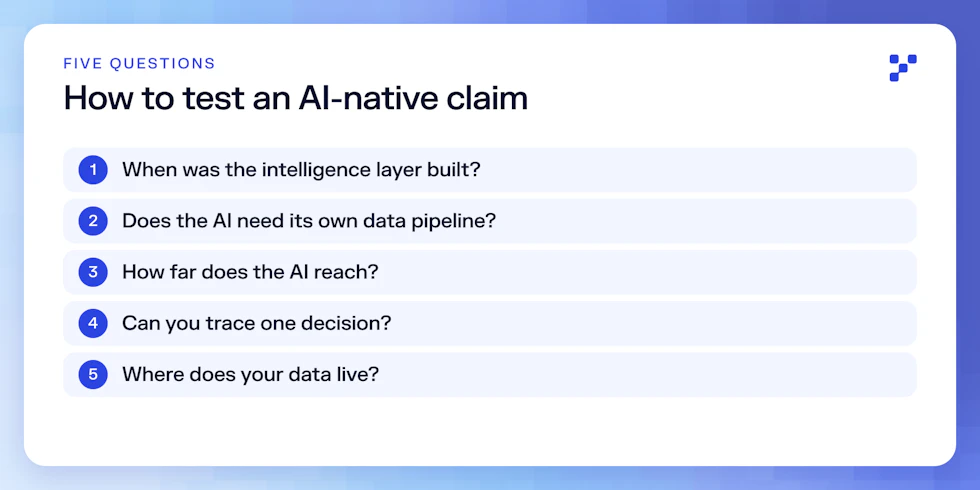
Ask five questions, and listen for specifics. They come from our own guide for carriers evaluating tech vendors.
- Ask when the intelligence layer was built. Our guide asks: "Is your platform truly core AI-native, with the intelligence layer and operational layer built together from inception?" If you hear, "We have a few integrations and tools that we've built to get it there," you have your answer.
- Ask whether AI needs its own data pipeline. If deploying AI means a separate pipeline, APIs, and integrations, there's no unified data layer underneath.
- Ask how far the AI reaches. Does it support the whole lifecycle, from submission to claims and billing? AI that stops at document intake isn't especially helpful to a carrier.
- Ask to trace one decision. Pick a recent AI-assisted decision and ask to see the data and logic behind it. When governance is added after the core was built, that trace is hard to produce.
- Ask where your data lives. Is your environment isolated from other clients? Does the vendor train models on your data?
A vendor that's truly AI-native should be able to answer all five in the first meeting. We cover all fifteen of our vendor questions in 15 questions to ask insurance software vendors before you sign.
How our platform does it
Here's how we built ours, so you have something concrete to test other claims against.
- One connected platform. Our platform unifies underwriting, claims, billing, reporting, origination, and policyholder experiences into one system.
- Seven agents, one intelligence layer. WorkForce, PolicyForce, OnForce, AssistForce, InspectForce, PulseForce, and PrintForce each handle one workflow, and they share what they learn.
- A dedicated environment for each carrier. Your own database, your own agents, and your data inside your own security boundary. We never train on your data.
- Visible logic. Every decision is logged: who decided what, when, and why. Compliance and regulators can review it.
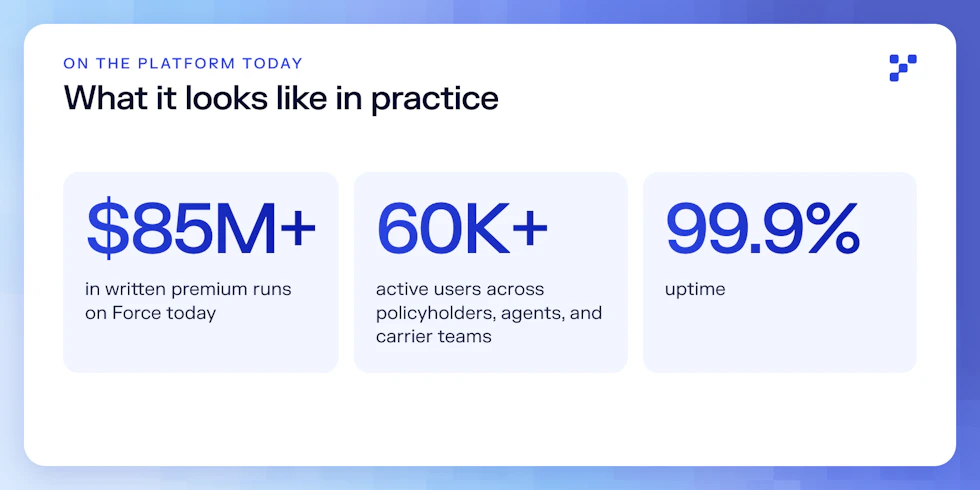
It's already running at carrier scale. There's $85M+ in written premium running on Force, with 60K+ active users across policyholders, agents, and carrier teams, and 99.9% uptime.
The environment question deserves its own look. As our vendor guide puts it: "If the vendor is sharing any of your resources in a multi-tenant environment, security is compromised. Period."
We set out the trade-offs in multi-tenant vs dedicated environments for insurance software.
Key takeaways
- An AI-native insurance platform is one where the intelligence layer and the operational layer were built together from the start, as one system.
- Bolted-on AI sits beside the work, needs its own data pipeline, and loses context as work crosses from one function to another.
- AI-native doesn't mean ripping out your core on day one. Agents can run alongside it as the on-ramp to a new core.
- Five questions test any vendor's claim: when the intelligence was built, how data reaches it, how far it reaches, whether decisions trace, and where data lives.
- The commercial point is speed to market. When rules, rating, and workflow live in one place, a new line doesn't wait endlessly on a rebuild.
Frequently asked questions
What does core AI-native mean in insurance?
It means a platform whose intelligence and operations were built together from inception. The AI works inside underwriting, claims, billing, and policy admin, on one set of data, under the carrier's rules. It isn't a feature added to an older system.
How is it different from adding AI to an existing system?
Added AI sits beside the system that does the work, so it reaches data through separate pipelines and integrations. When work crosses from one function to the next, it can lose context. An AI-native platform carries that context across the lifecycle and is traceable by design.
Does core AI-native mean replacing the core system?
Not to start. Our agents run alongside the core system you already have, in your own dedicated environment. They're the on-ramp to a new core, and you move the rest when you're ready.
How can a carrier check a vendor's AI-native claim?
Ask when the intelligence layer was built, whether AI needs a separate data pipeline, and whether it covers the lifecycle from submission to claims and billing. Then ask to trace one decision back to its data and logic, and ask where your data lives. If the answers are about tools still "in progress," you've learned what you needed to.
Related: Insurance Core System Implementation Failure: Why It Happens
Final thoughts
You'll hear "AI-native" from a lot of vendors this year. That's a reason to define it, not to ignore it.
The real version is simple to describe and hard to fake. Intelligence and operations built together, one connected platform, your own environment, and decisions you can trace.
The fastest way to find it is to ask. Five questions, one meeting, and you'll know.
The real version is simple to describe and hard to fake.
See it on your operations
Bring us the workflow that slows your team down most. We'll show you what AI-native looks like on it.
Book a demo of Force and see our platform on the process your team would most like to stop doing by hand.