15 Questions to Ask Insurance Software Vendors Before You Sign
Every vendor looks good in a demo. What matters is what a demo can't show: how it was built, where your data lives, and who fixes it when it breaks.
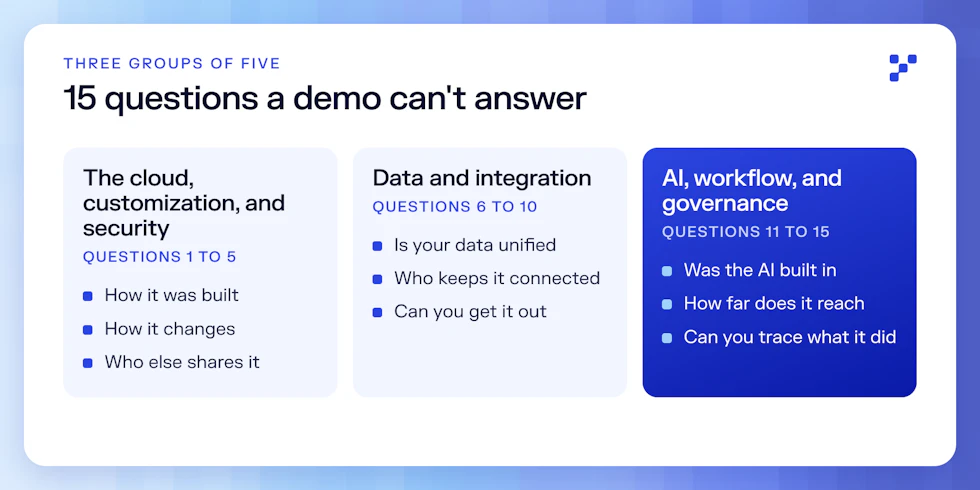
Here are the 15 questions we'd ask, in three groups of five. Each one comes with what you'll probably hear back and, more importantly, what that answer really means.
Our view is simple. If a vendor can't answer these in plain words before you sign, you'll pay to find out after.
The short answer
Ask about four things: architecture, data, AI, and governance. They're the parts of a platform you can't see in a demo and can't easily change once the contract is signed.
The 15 questions below come from our own vendor guide, "15 Questions for your tech vendors." We've kept its three groups:
- The cloud, customization, and security (questions 1 to 5): how it was built, how it changes, and who else shares it.
- Data and integration (questions 6 to 10): whether your data is unified, who keeps it connected, and whether you can get it out.
- AI, workflow, and governance (questions 11 to 15): whether the AI was built-in, how far it reaches, and whether you can trace what it did.
Yes, we're a vendor too. Ask us every one of them. That's the point of publishing them.
Why the demo isn't enough
Because a demo shows you the best day, not the next five years. Adam Ibrahim, our co-founder and CEO, told Digital Insurance in September what he sees as the biggest mistake insurtechs make.
"The biggest mistake is bolting on untested tools with nice looking demos rather than thinking from their existing core systems and infrastructure outward."
He also named the cost of that habit. "The real downside is even worse: carriers are increasingly skeptical of any claims insurtechs make, given how ubiquitously carriers have been previously burned."
We think that skepticism is healthy. It's also why a good vendor should welcome hard questions. They're the fastest way to show the product actually works.
Adam came to Force from the carrier side, after five years on the board of a regional P&C carrier. These questions are written for that side of the table.
The biggest mistake is bolting on untested tools with nice looking demos rather than thinking from their existing core systems and infrastructure outward.
How to use the list
Use them early, in writing, and with every vendor on your list. A few habits make the answers far more useful:
- Send them before the demo. Ask for written answers, so you can compare vendors line by line.
- Ask to see it, not hear about it. If the answer is yes, ask them to show you on a workflow you actually run.
- Ask every vendor the same 15. Including us. The value is in the comparison.
- Write down the tense. "We do" and "we will" are different answers.
- Bring the people who'll live with it. Underwriting, claims, IT, and compliance each hear something different in the same answer.
You won't need all 15 for every purchase. A tool for one workflow may only need the security and data questions, while a core system decision needs all of them. If you run a mid-size carrier, we've set out the priorities in what to look for in insurance software for mid-size carriers.
Cloud, customization, and security
These five tell you how a vendor's platform was built. That decides how expensive every change will be for as long as you use it.
1. Was your platform originally built on a monolithic structure?
What you'll hear: "We are shifting to a microservices oriented architecture."
What this means: our guide is blunt about it. "Yes, they were built monolithically. When AI is a bolted-on feature, maintenance and updates are incredibly expensive and unless the codebase is completely overhauled, technical debt will grow exponentially."
The alternative is a platform built in separate pieces. "A microservices/modular platform inherently avoids technical debt, because the underlying code is separated from customizations you make."
2. How do you handle customization? Do you require proprietary code and specialized engineers?
What you'll hear: "Don't worry, things are 'in progress' or 'will be shipped soon.'"
What this means: "A vendor's version of 'soon' and your version of soon are often vastly different. To avoid difficult and fragile integrations, AI-software stacks require standardized API documentation and universally understood programming languages that are ready now."
Ready now is the test. If every change needs the vendor's specialized engineers, you're working on their calendar, not yours.
3. Will our customizations affect the core platform code?
What you'll hear: "We are more configurable than other vendors."
What this means: maybe so. Ask whether "configurable" covers launching new products or building document templates in real time. "If the answer is no, you'll be stuck, sadly, designing your operations around the vendor's system rather than being able to customize the system rapidly and continuously around YOUR ideal workflows."
Then the line that matters most: "Remember, configurations are what enable you to customize your systems and launch products faster while not creating technical debt with code modifications."
Related: Multi-Tenant vs Dedicated Environments for Insurance Software
4. Do your system upgrades require manual control over timing and extensive retesting?
What you'll hear: "Lots of things can be done right away."
What this means: "Typically, this does not include custom reporting and analytics or using AI agents to do useful work."
Upgrades that arrive without disrupting your operation are a sign of an integrated design. If every upgrade turns into a retesting project, ask why.
5. Regarding security, is our compute environment and infrastructure physically isolated from other clients?
What you'll hear: "Pretty much; your policy-holder data is isolated."
What this means: "If the vendor is sharing any of your resources in a multi-tenant environment, security is compromised. Period." The guide's alternative: "You'll want a dedicated cloud environment local to your business, with no shared data or code bases."
Isolated data and an isolated environment aren't the same thing. We break down the difference in multi-tenant vs dedicated environments for insurance software.
Data and integration
AI is only as useful as the data it can reach. These five tell you whether your data is unified, who keeps it connected, and whether it's really yours.
6. Will deploying AI require a separate data pipeline, APIs, and integrations?
What you'll hear: "We're developing a fix for that. It's in beta right now."
What this means: "They don't have a unified data layer, which provides AI access to operational data without extraction or transformation."
Every separate pipeline is one more thing to build, pay for, and keep running.
7. How do you help us migrate data?
What you'll hear: "Yes, our consultants can help you with that."
What this means: "If your historical data requires a separate remediation project to make it AI-ready, costs will rise exponentially."
So ask who does the work. Then ask whether making your data AI-ready is part of the plan or a second project.
8. Does your architecture ensure that policy, claims feedback, underwriting, and analytics are unified and instantly available in real time, through a shared data layer?
What you'll hear: "Somewhat, but we connect other things through data pipelines."
What this means: a lack of real-time data access, in our guide's words, "adversely affects decisions on a huge number of levels." Somewhat means connected after the fact, not unified.
If you're an MGA building your stack, the order you connect things in matters just as much. We cover it in what to connect before you scale.
9. Who is responsible when an integration breaks: us, the third-party vendor, or you? Do you build and maintain external connections as fully owned add-on modules?
What you'll hear: "We will work with the third-party to re-establish the integration, but we can't be responsible if they have an issue."
What this means: "If you want real-time support, your vendor should provide it, for maintenance, system customizations/configurations, and integrations of new tools and features."
Get that answer in the contract, not just on the sales call.
10. Can we easily extract and use our data for any advanced analytics purpose, independent of your built-in tools?
What you'll hear: "Sure, you can download it all."
What this means: "Exactly how available the downloads are is the key question. If you must click millions of buttons to extract your own data, you can see it's not really available, usable, and uncorrupted."
Ask them to show you an export. Your data should stay yours, on the way out as well as the way in.
AI, workflow, and governance
This is where demos look most convincing and answers get most slippery. These five separate AI that was built-in from AI that was added on.
11. Is your platform truly AI-native, with the intelligence layer and operational layer built together from inception?
What you'll hear: "We have a few integrations and tools that we've built to get it there. This is enough of a workaround."
What this means: "If AI is a bolted-on feature, it often will suffer from 'amnesia' as the workflow crosses functional boundaries."
The claim doesn't know what underwriting decided. Billing doesn't know about the claim. We go deeper on the difference in what an AI-native insurance platform is, and what it isn't.
12. Does your AI support the entire insurance lifecycle, from submission to claims and billing?
What you'll hear: "AI is being implemented throughout our system."
What this means: "AI intelligence that focuses on front-end tasks like document intake is not especially helpful to a carrier."
Ask where the AI stops. Then ask what happens to the work after that point.
13. Is your platform capable of supporting all three levels of intelligence (rules-based automation, machine learning, and generative/agentic AI) in an integrated system?
What you'll hear: "We're testing AI tools that give insights."
What this means: "Isolated capabilities requiring separate integrations are costly, both in terms of time and money, and often don't even work."
Rules, models, and agents each do a different job. You want them working in one system, not three.
14. Were governance and auditability (specifically the ability to trace AI-assisted decisions back to the data and logic) built into the architecture?
What you'll hear: "No. But we're testing something now."
What this means: governance and auditability added after the core system was created "makes it difficult to trace AI-assisted decisions back to the data and logic, resulting in regulatory non-compliance and a lack of transparency."
Regulators are asking similar questions. The NAIC's model bulletin on insurers' use of AI systems, adopted December 4, 2023, says an insurer's AI program should cover AI systems "whether developed by the Insurer or a third-party vendor."
It also points insurers toward contract terms with third parties that "Provide audit rights and/or entitle the Insurer to receive audit reports by qualified auditing entities." It's a model, so each state decides whether to adopt it. Either way, the lesson is clear.
Related: Premium Leakage: How Disconnected Systems Quietly Cost Carriers Money
15. Does your underwriting system provide for real-time instant updates between underwriting, policy administration, and claims experiences?
What you'll hear: "Sort of. We batch certain things and we use APIs between the functions."
What this means: "One of the major causes of premium leakage (i.e., lost money) is when reinsurance is not auto-populated based on policies and claims events."
Batch means waiting. Waiting is where money slips through.
Ask for the audit trail in the demo and the audit rights in the contract.
Answers that should worry you
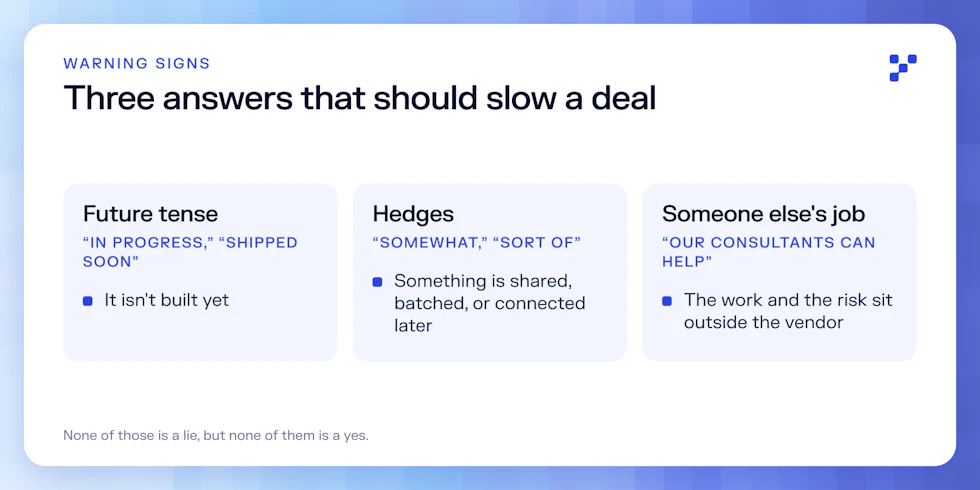
Read the "what you'll hear" lines back to back and a pattern shows up. The weak answers fall into three groups:
- Future tense. "Shifting to," "in progress," "shipped soon," "developing a fix," "in beta," and "testing." It isn't built yet.
- Hedges. "Pretty much," "somewhat," and "sort of." Something is shared, batched, or connected later.
- Someone else's job. "Our consultants can help" and "we will work with the third-party." The work and the risk sit outside the vendor.
None of those is a lie. But none of them is a yes.
When you hear one, ask what it means for your timeline, your data, and your regulator. Then ask when it'll be live, and get the date in writing.
None of those is a lie, but none of them is a yes.
Our answers
Fair question. Here's the short version, in the same three groups. Hold us to every line in a demo.
The cloud, customization, and security. Our platform is built as true microservices, with zero-downtime updates. Customization runs through configuration, with an API toggle system and flexible workflows, so your team can launch new lines without developer dependency.
Every carrier gets its own dedicated environment. That means your own database, your own agents, and your data isolated inside your own security boundary.
Data and integration. Our platform is one connected operating system. It unifies underwriting, claims, billing, reporting, origination, and policyholder experiences into one system.
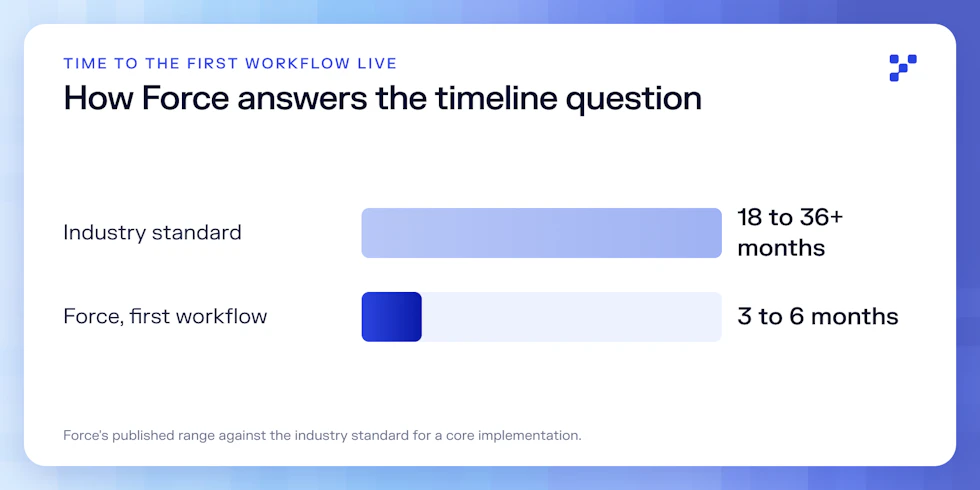
The first workflow goes live in 3 to 6 months, against an industry standard of 18 to 36+ months. You get direct access to our engineers throughout, and your data stays yours.
AI, workflow, and governance. Our platform is core AI-native, built from the ground up to support automation and AI as your business is ready for it. Seven agents cover the work, from policy lifecycle orchestration to inspections, analytics, and print and mail.
Rules-based automation, machine learning, and generative and agentic AI run in one integrated system. Every AI decision leaves a full audit trail: who decided what, when, and why. Agents do the work, only exceptions and edge cases go to a person, and we never train on your data.
You don't have to buy all of it to start. Give us a problem, we fix it with one modern, customizable, fast-to-ship microservice. It runs in your own environment from day one, the on-ramp to your new core, not a layer bolted onto the old one.
Moving to a modern core like ours is still the step carriers eventually need to take. Microservices and agents are the on-ramp.
That's not a promise about the future. $85M+ in written premium runs on Force today, with 60K+ active users across policyholders, agents, and carrier teams.
From questions to a shortlist
A shortlist. The questions tell you who's worth a second meeting, so score every answer the same way:
- Shown. They said yes and proved it on your workflow.
- Said. They said yes but didn't show it.
- Soon. Future tense, beta, or testing.
- No. At least it's honest.
A vendor with mostly "shown" answers earns the next conversation. A vendor with mostly "soon" answers is asking you to fund their roadmap.
If you're still building the list of who to ask, our guide to the best AI platforms for insurance carriers sets out how to compare point solutions and platforms.
Key takeaways
- The questions that matter most are the ones a demo can't answer: architecture, data, AI, and governance.
- Force's 15 questions come in three groups of five, each with what a vendor will say and what that answer really means.
- Future tense, hedges, and handing the work to someone else are the three answer patterns that should slow a deal down.
- A dedicated environment, a unified data layer, and AI-native architecture are what a carrier should expect, not extras.
- Ask for the audit trail in the demo and the audit rights in the contract.
Frequently asked questions
What should I ask an insurance software vendor before shortlisting them?
Start with how their platform was built, whether your environment is isolated, who maintains integrations, and whether AI decisions can be traced. Those four areas cover the 15 questions in this guide. Ask for written answers, then ask to see each "yes" on a workflow you run.
How do I tell AI-native from AI added on top?
Related: Insurance Core System Implementation Failure: Why It Happens
Ask whether the intelligence layer and the operational layer were built together from inception. Bolted-on AI tends to lose context as work crosses from underwriting to claims to billing. AI-native platforms carry that context through the whole lifecycle, in one system.
Who is responsible when an integration breaks?
It should be your vendor. Our guide's view is that your vendor should provide real-time support for maintenance, customizations and configurations, and integrations of new tools and features. If the answer starts with "we will work with the third-party," get the responsibility written into the contract.
Is our data isolated from other customers?
Ask whether your compute environment and infrastructure are physically isolated, not just whether your data is. In a multi-tenant environment, resources are shared. With Force, every carrier gets its own dedicated environment, with its own database and its own security boundary.
Final thoughts
Carriers have been burned before, and they're right to be skeptical. The answer to skepticism isn't a better demo. It's better questions.
These 15 cover the parts of a platform you'll live with for years. They ask how it's built, where your data sits, who keeps it running, and whether you can explain what the AI did.
Ask them of every vendor on your list, including us. The good answers are short, specific, and shown.
The vendors worth signing with won't mind the questions. They'll be glad you asked.
See it on your own operations
Bring the 15 questions to a demo and ask us every one. We'll show you the answers on your own workflows, not a slide.
Book a demo of Force and start with the question that worries you most.