
Insurance Software for Mid-Size Carriers: What to Look For
A mid-size carrier can't stop running while it changes its technology. That one fact should shape every software decision you make.
So the best insurance software for mid-size carriers changes one thing at a time. It should help you launch a new product, line, state, or program faster, run in your own environment, and go live without a big-bang cutover.
Our view: the carriers that come out ahead won't be the ones with the biggest budgets. They'll be the ones that keep moving.
The short answer
Six things, in this order:
- Speed to market. Software that helps you launch a new product, line, state, or program, much faster.
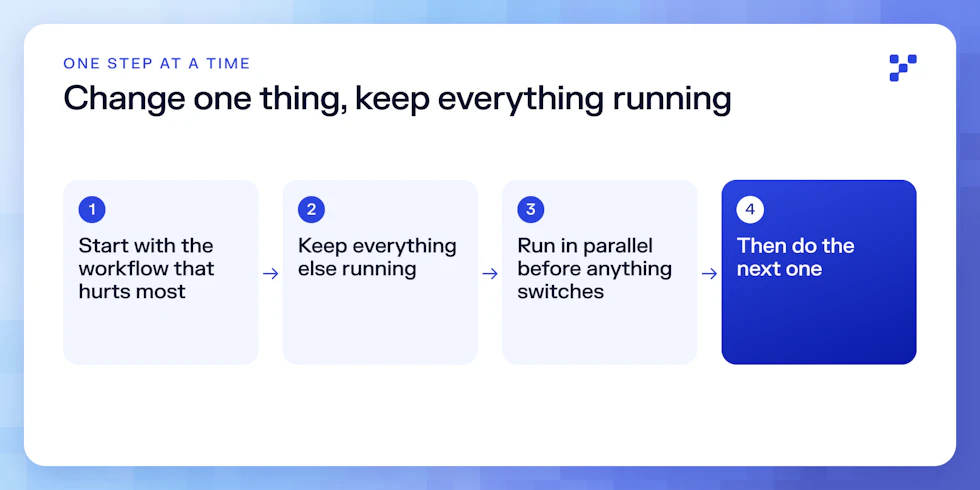
- One step at a time. Start with the workflow that hurts most and keep everything else running.
- A short, safe path to live. Months, not years, with a parallel run before anything switches over.
- Your own environment. A dedicated, isolated environment, not a slice of someone else's.
- Configuration your team owns. Business users change products and workflows without developer dependency.
- Easy adoption. Something your teams, agents, and policyholders can pick up quickly.
The rest of this guide takes them in turn. Running an MGA rather than a carrier? The order shifts a little, and we cover it in what to connect in an MGA tech stack before you scale.
The real constraint
Because the people who'd run a big software project are the same people running the business. You still answer to compliance and regulators. Underwriting, claims, billing, and reporting still have to work every day.
Legacy tech makes that harder. Insurance software is fragmented, with separate tools for underwriting, claims, billing, reporting, agents, and policy admin. The result is manual handoffs, duplicated work, and slow product launches.
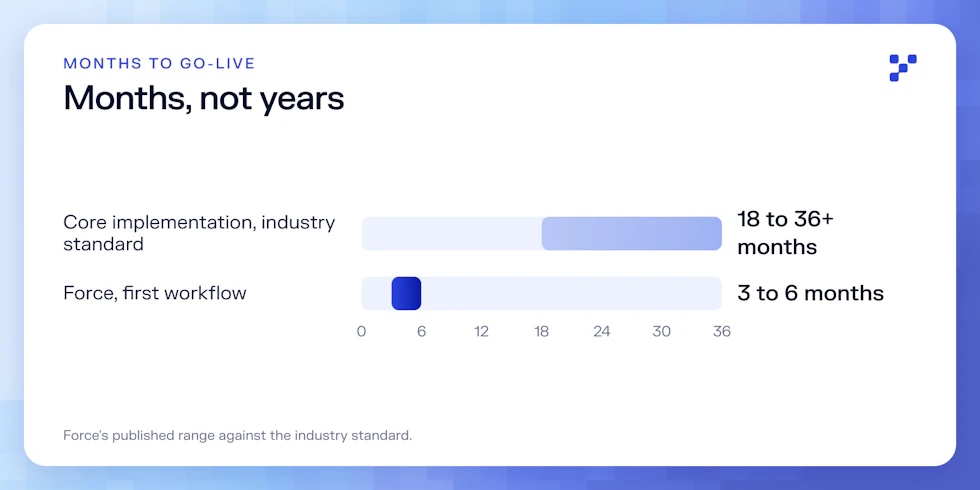
The old methodology is a full core replacement, and the industry standard for that is 18 to 36+ months. For a mid-size carrier, that's a long time to ask your best people to do two jobs.
A mid-size carrier's real constraint is that the business can't stop while the technology changes.
Small steps, kept up
Because that's how real change happens in insurance. Adam Ibrahim, our co-founder and CEO, told Digital Insurance in September how he expects AI to change the industry over the next five years.
"There will be transformation, but it will happen incrementally, in the form of single digit improvements in efficiencies and the product over time in those carriers who are most proactive and willing to drive change."
His point is about AI across the whole industry. Gains build up step by step, in the carriers that keep taking the steps.
That's good news for a mid-size carrier. You don't need the biggest budget to be one of the proactive ones. You need to start, and then keep going.
There will be transformation, but it will happen incrementally, in the form of single digit improvements in efficiencies and the product over time in those carriers who are most proactive and willing to drive change.
Make money first
Because growth is the prize a mid-size carrier can least afford to miss. The best reason to change your technology is to take a new product, line, state, or program to market faster, without ripping out the system underneath.
That's where we start. Our platform is adaptable by design, with an API toggle system and flexible workflows built for launching new lines. PolicyForce gives business users natural-language guided product configuration, covering rating rules, endorsements, and lifecycle management.
OnForce reads your policy documents and extracts the rating variables, eligibility rules, and regulatory requirements inside them. Weeks of onboarding work, done in days.
Savings come too, and when you get to cost, start with where the expense ratio savings really are. But the first job is to help you make money.
No rip and replace
Yes. You don't have to rip out your whole system to start. Give us a problem, we fix it with one modern, customizable, fast-to-ship microservice.
Start with your biggest pain point. Keep everything else running exactly as it does now.
Our microservices and agents run in your own dedicated environment from day one. Each one is the on-ramp to your new core, not a layer bolted onto the old one.
We won't pretend the core never matters. Moving to a modern core like ours is still the step carriers eventually need. Microservices and agents are the on-ramp, and through them our clients, in Adam's words, "can modernize on their own timeline."
We set out the step-by-step version in how to modernize an insurance core system without a three-year migration.
Time to live
Months, not years. The industry standard for a core implementation is 18 to 36+ months. Our published range is 3 to 6 months to the first workflow live.
Speed only counts if it's safe. Our five-phase process includes a parallel run against your current system in weeks 10 to 16, with acceptance criteria your team signs off on. Nothing goes live until it does.
But the calendar that matters most is yours. At a mid-size carrier, the people who test new software also run the business. A vendor can be ready in week 10 and still wait a month for your underwriting lead to find a free afternoon.
So before you compare timelines, ask every vendor, including us, who on your side does the testing and how many hours a week it needs. Put those hours in the plan, not just the vendor's.
At a mid-size carrier, the people who test new software also run the business.
Your own environment
Because your policyholder data is your responsibility, whatever size you are. In a multi-tenant system, you share infrastructure with other customers. In a dedicated one, you don't.
Every Force carrier gets its own dedicated environment: your own database, your own agents, and your data isolated inside your own security boundary. It's configured to your business rules, and we never train on your data.
It's built to stay up, too. Our platform runs at 99.9% uptime, and it's designed for fast adoption across carrier teams, agents, and policyholders.
Questions to ask first
Start with three:
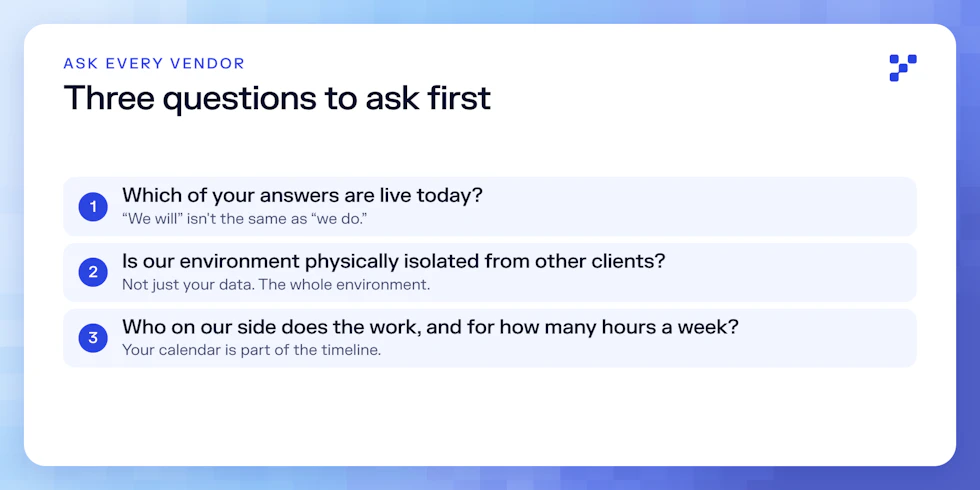
- Which of your answers are live today? "We will" isn't the same as "we do."
- Is our environment physically isolated from other clients? Not just your data, the whole environment.
- Who on our side does the work, and for how many hours a week? Your calendar is part of the timeline.
Then work through the full list in 15 questions to ask insurance software vendors before you sign. It covers architecture, data, AI, and governance, with what you'll hear back and what it really means.
Building the shortlist
The ones that pass those questions, and that are built for carriers rather than agencies. A point solution can fix one workflow well. A connected platform puts underwriting, claims, billing, and reporting in one system, so they work from the same data.
Force is built for mid-size to large carriers, across P&C, specialty, E&S, MGA, and expanding lines. $85M+ in written premium runs on Force today, with 60K+ active users across policyholders, agents, and carrier teams.
For a wider view of the options, see our guide to the best AI platforms for insurance carriers.
Key takeaways
- A mid-size carrier can't stop running while it changes, so the right software changes one thing at a time.
- Look for speed to market first: software that helps you launch a new product, line, state, or program faster.
- You don't have to replace your core system to start, because microservices and agents are the on-ramp to a modern core.
- The industry standard for a core implementation is 18 to 36+ months, and Force's first workflow goes live in 3 to 6 months.
- Ask every vendor how much of the timeline depends on your own people.
Frequently asked questions
What software do mid-size insurance carriers use?
Insurance software is fragmented, so a carrier often runs separate tools for underwriting, claims, billing, reporting, agents, and policy admin. That's where the manual handoffs and duplicated work come from. A connected platform puts those workflows in one system.
Can a mid-size carrier modernize without replacing its core system?
Yes. Start with one microservice or agent on the workflow that costs you most, running in your own environment next to the systems you already have. The full connected platform is where that can lead, on your timeline.
What should a mid-size carrier ask first?
Ask which answers are live today, whether your environment is physically isolated, and how much of the timeline depends on your own people. Then work through the 15 vendor questions on architecture, data, AI, and governance.
How long does it take to change systems?
The industry standard for a core implementation is 18 to 36+ months. Force's first workflow goes live in 3 to 6 months, after a parallel run against your current system. Each module after that follows the same process, and later modules deploy faster.
Final thoughts
Mid-size carriers don't need a moonshot. They need a first step that works, and then a second one.
Look for software that helps you grow first, runs in your own environment, and goes live in months with a parallel run behind it.
Ask every vendor, including us, how much of the timeline depends on your people.
The carriers that come out ahead will be the proactive ones. Being proactive is a decision, not a budget line.
See it on your own operations
Bring us the workflow that's slowing you down most. We'll show you what fixing it looks like, with everything else left running.
Book a demo of Force and see the first step on your own operations.