How Long Does an Insurance Core System Implementation Take?
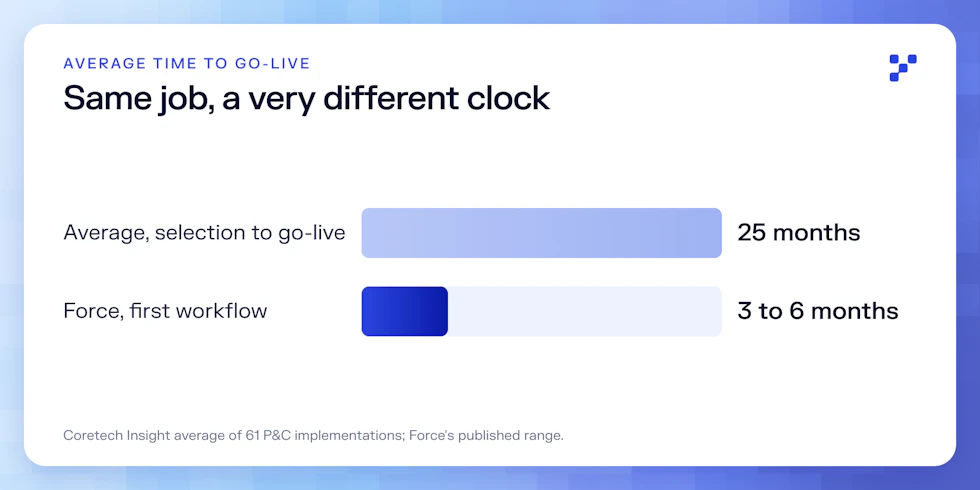
A traditional insurance core system implementation takes 18 to 36+ months. An independent study of 61 P&C implementations put the average at 25 months from selection to go-live. On our platform, the first workflow goes live in 3 to 6 months.
So which number is yours? Our honest view is that the software decides less of it than anyone admits. Your scope and your people decide most of it.
Here's what drives the timeline, what happens week by week, and what "go-live" should mean before you sign anything.
The short answer
The research says about two years. The industry standard for a full core replacement is 18 to 36+ months.
Coretech Insight, an independent research firm, went to the public record for an answer. In April 2022 it reviewed 980 press releases from P&C core system vendors in the US and Canada. It found 61 implementations with both a published selection date and a published go-live date.
The average from selection to go-live was 25 months.
Our answer is different because we time something different. We don't wait for the whole system to be ready. We put one workflow live in 3 to 6 months, while your legacy tech keeps running everything else.
What the data shows
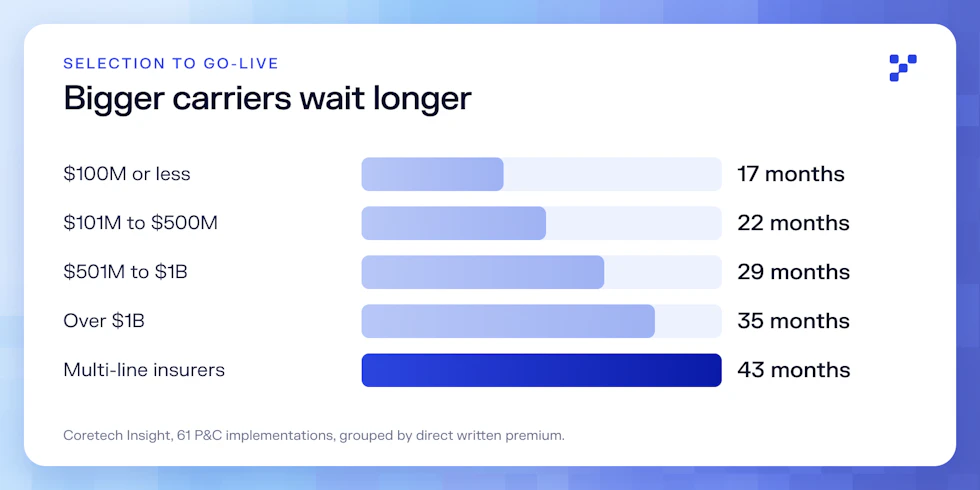
Size matters. Coretech found a strong link between an insurer's direct written premium and its time from selection to go-live:
- $100M or less: 17 months
- $101M to $500M: 22 months
- $501M to $1B: 29 months
- Over $1B: 35 months
Scope matters too. In a June 2022 follow-up, Coretech looked at the 18 insurers that went live with everything at once. That meant every core module, every line of business, and every state. The multi-line insurers in that group averaged 43 months.
Its advice was to divide the work into manageable chunks, so the time to each go-live stays under 24 months. We'd go a step further. Make the first chunk one workflow.
What drives the timeline
Randy Shain, our Chief Business Development Officer, was asked this recently by another software company. His honest answer was that it depends on your people more than on our software.
The software work is the part we control. The rest sits on your calendar:
- Scope. How much has to be live on day one. One workflow is a project. Every line in every state is a program.
- Discovery. How much of your operating logic lives in manuals versus how much is only in people's heads. BCG calls understanding how legacy systems actually work one of the toughest, most time-consuming steps in modernization.
- Data. How much history has to move, and how clean it is when it lands.
- Testing. Who on your side checks the results, and how many hours a week they have.
- Sign-off. Whether "done" was defined in writing before anyone started building.
Randy's advice: "ask any vendor, including us: who on our side tests this, and how many hours a week do they need?" A vendor that can't answer hasn't planned for it.
Your scope and your people decide more of your timeline than the software does.
Five phases, week by week
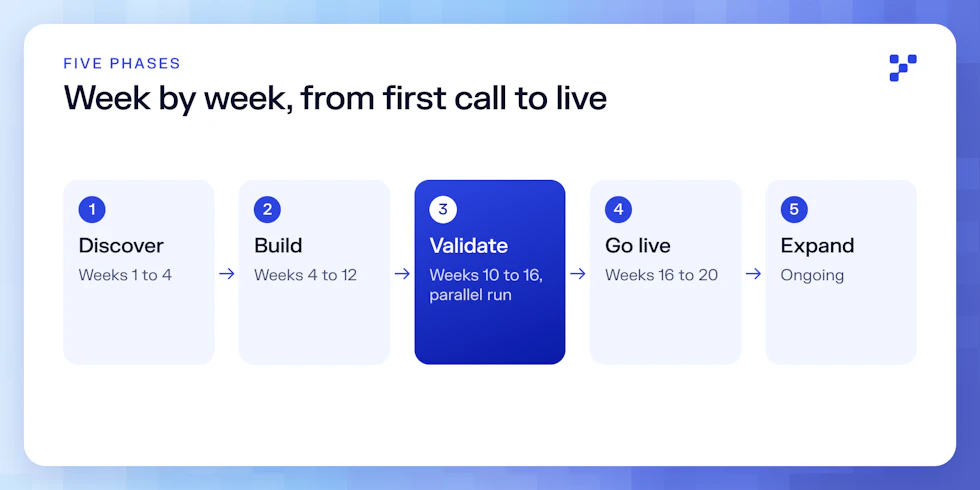
Every implementation we run follows the same five phases. Each phase has defined deliverables, clear ownership, and a gate before moving forward. The full method is in how Force implements: five phases, one clear path.
- Discover, weeks 1 to 4. We build a carrier ontology: a structured map of your operational logic. It comes from your rating manuals, product guides, operational procedures, system inventory, organizational structure, reinsurance arrangements, and priority workflows.
- Build, weeks 4 to 12. Three workstreams run in parallel: platform configuration, data migration and integrations, and automation design. Your team defines which tasks require human oversight.
- Validate, weeks 10 to 16. Our platform runs alongside your existing system and processes the same work. Outputs are compared, and discrepancies are identified and resolved.
- Go live, weeks 16 to 20. A controlled, supported launch, followed by a defined HyperCare period. Ownership transfers when your team is trained, operational, and in control.
- Expand, ongoing. Each new module follows the same process. Later modules deploy faster because the foundation is already in place.
Why it's faster
Because the unit of change is smaller, and the slowest step gets faster.
Adam Ibrahim, our co-founder and CEO, told Digital Insurance in September that Force typically integrates in months, not years, through AI-assisted implementation. In practice that starts in Discover.
Our OnForce agent reads your policy documents and extracts rating variables, eligibility rules, and regulatory requirements. Weeks of onboarding work, done in days.
Adam also named what slows everyone else down: "It is under-appreciated how much existing technical debt and maintenance sit in the core systems and infrastructure that powers the industry."
So we don't start by ripping out legacy tech. Microservices and agents are the on-ramp. Give us a problem, we fix it with one modern, customizable, fast-to-ship microservice, running in your own environment from day one.
It's the on-ramp to your new core, not a layer bolted onto the old one. Moving to a modern core like ours is still the step carriers eventually need. We explain how to take it in stages in how to modernize an insurance core system without a three-year migration.
"It is under-appreciated how much existing technical debt and maintenance sit in the core systems and infrastructure that powers the industry." Adam Ibrahim, Force co-founder and CEO
The parallel run
In our plan, it's part of the schedule, not an extra stage on the end. Validation runs from week 10 to week 16, overlapping the end of the build, so you see real output before configuration is finished.
It also heads off a classic delay: arguing at the end about whether the system works. Formal acceptance criteria are defined before validation begins, so nobody negotiates what "working" means under pressure. Nothing goes live until you sign off.
Your legacy system keeps processing live work the whole time. We break the method down in what a parallel run is and why it's the safest way to go live.
Define go-live first
Define it before you ask how long. Coretech defines go-live simply as the first use of a system in production, and the scope varies from one go-live to the next. Half of the go-live announcements in its study already cited follow-on plans.
So go-live is a milestone, not the finish line. In our plan, it means one workflow, live and owned by your team.
A go-live nobody defined is a go-live nobody can reach. We cover the other reasons projects fail in insurance core system implementation failure: why it happens.
Going live on one workflow is the beginning, not the end.
Test the timeline
Ask questions where a vague answer is easy to spot:
- Ask what goes live first. One workflow, or the whole system? A date without a scope tells you nothing.
- Ask who tests it. Get a name, and the hours a week they'll need.
- Ask when acceptance criteria get written. Before validation, or during it?
- Ask what runs while you wait. Your legacy tech should keep handling live work until you sign off.
- Ask who you'll work with. You want the engineers building your system, not a support tier.
We've put a fuller list in 15 questions to ask insurance software vendors before you sign.
Key takeaways
- A traditional insurance core system implementation takes 18 to 36+ months. Coretech Insight's study of 61 P&C implementations found an average of 25 months from selection to go-live.
- In that research, timelines grew with the insurer's size and with how much went live at once.
- Scope, discovery, data, testing, and sign-off drive the timeline, and several of those depend on the carrier's people more than on the vendor's software.
- On our platform, the first workflow goes live in 3 to 6 months through five phases, with a parallel run in weeks 10 to 16.
- Define "go-live" before you ask how long, because a date without a scope tells you nothing.
Frequently asked questions
How long does an insurance core system implementation usually take?
The industry standard for a full core replacement is 18 to 36+ months. Coretech Insight's 2022 review of 61 P&C implementations found an average of 25 months from selection to go-live, from 17 months for insurers writing $100M or less to 35 months for those over $1B. On our platform, the first workflow goes live in 3 to 6 months.
What decides how long it takes?
Scope comes first: how much has to be live on day one. After that it's discovery, data migration, testing time, and how clearly "done" was defined. Several of those depend on your people's calendar more than on the software.
Can a carrier go live one workflow at a time?
Yes. You choose the first workflow, maybe underwriting, claims intake, or billing, and your legacy systems keep running everything else. Each later module follows the same process and deploys faster.
Does a parallel run add time or save it?
In our plan, it's built into the schedule rather than added on, because validation overlaps the end of the build. It also surfaces discrepancies while there's still time to fix them, before go-live.
Final thoughts
The research answer is about two years. The industry answer is 18 to 36+ months. Neither tells you much until you know what's in scope.
Shrink the first step to one workflow, and the number changes. So does the risk.
Ask every vendor the same three things, including us: who tests it, when "done" gets written down, and what keeps running while you wait.
The fastest implementation is the one where everyone agreed what finished looks like before the work began.
See it on your own operations
We'll walk you through the five phases for your first workflow.
Book a demo of Force and bring the workflow you'd most like live first.